Healthy LIVING while aging! (2025-03)
In this edition
- Food Connects Us
- 2025 Dietary Guidelines for Older Adults
- MyPlate for Older Adults
About the Newsletter
For National Nutrition Month, come read about how "Food Connects Us" as a community. In this newsletter, you can also read about the 2025 Dietary Guidelines for Older Adults and learn about MyPlate and the five food groups.
Food Connects Us
By: CJ Kelley, M.S.
This year’s National Nutrition Month theme focuses on how "Food Connects Us." Between holiday meals and community events, we hear lots about how food connects us, but have you ever wondered what connects food? The answer is —The Food System, a complex network of people, places, and processes working behind the scenes to produce the food on your table. By the time our food reaches us, we are nearing the end of its journey. To better understand this journey, let’s retrace the steps of a blueberry muffin, a product that has taken a journey across the world to get to your kitchen. Let’s begin one step from the end.
Food Connects Us Logo
You may have purchased your pack of muffins from the grocery store. The grocery store waited for its arrival from a delivery truck driving across the states bringing the muffins from a packaging facility. This facility followed strict food safety rules after getting the fresh baked muffins from the bakery where it was made.
The baker mixed eggs, blueberries, sugar, flour and butter/oil to create your muffin weeks earlier. Each of these ingredients came from packagers and processors in factories who cleaned the eggs, sorted the blueberries, refined the sugar, milled the flour, and churned the butter or pressed the oil. These factories ordered the raw ingredients from farms, where thousands of hands planted, cared for and harvested their products. These farms can originate as far as Indonesia (in the case of palm oil) or from across the United States, though not usually in Nevada.
Usually, the more far reaching the journey our food takes through the food system, the more it contributes to the cost of groceries in having to pay more for goods that were produced farther away. These goods are not as fresh, meaning they are less nutritious, have a decreased shelf life, and can lead to worsened food security. We end up spending more money on goods making a larger, negative impact on our environment.
The more expensive our food is, the more difficult it is for folks to make ends meet. All for a choice of food that ends up less nutritious and more harmful to the environment. According to the federal government’s Joint Economic Committee, Nevada households already spend $87 more on average each month to maintain the same standard of living as the rest of the country.
So, what can we do about this? Support our local growers and makers! We have the power to make informed decisions and buy more locally made products, which supports these items becoming more readily available. One option to get better quality, more nutritious and longer lasting food is to seek out farms, producers and restaurants that create and use locally grown products. On MADEINNEVADA.ORG, you can find local farms and farmers markets near you selling amazing products grown in Nevada, for Nevadans. Doing this helps solve the problems that our community faces: food insecurity, increased prices, farmer insecurity and climate change. We can better connect ourselves to our food by connecting it to the land and hands that grew it.
Food Connects Us Information
USDA's 2025 Dietary Guidelines for Older Adults
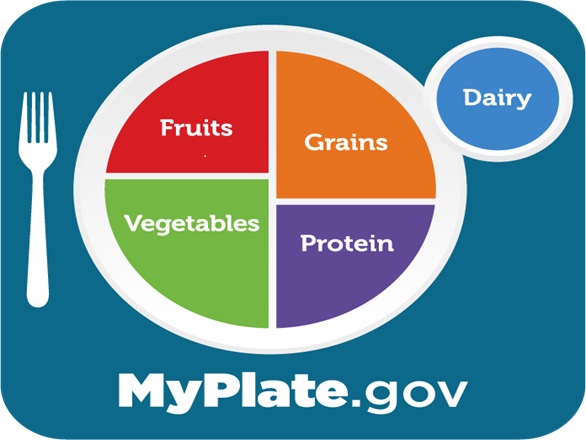
While the core principles of the USDA's 2025 Dietary Guidelines for older adults remain largely the same as the 2020 guidelines, the newer version places a stronger emphasis on consuming more plant-based foods like vegetables, fruits, legumes and whole grains, while further emphasizing the need to limit red and processed meats, added sugars and saturated fats, with a focus on incorporating more unsaturated fats from sources like fish and vegetable oils; overall, the 2025 guidelines aim to promote a more personalized approach to healthy eating tailored to individual needs and preferences across the lifespan.
Key differences between the 2020 and 2025 Dietary Guidelines for older adults:
- Increased focus on plant-based foods: The 2025 guidelines encourage an even higher intake of vegetables, fruits, legumes, nuts and whole grains than the 2020 version.
- Reduced red and processed meat intake: The 2025 guidelines strongly advise limiting the consumption of red and processed meats due to their potential health risks.
- Emphasis on unsaturated fats: A greater focus should be on incorporating healthy unsaturated fats from sources like fish and vegetable oils.
- Tailored approach to calorie needs: The 2025 guidelines recognize the variability in calorie needs among older adults and encourage personalized dietary adjustments based on individual activity levels and health status.
The 2025 Dietary Guidelines for Older Adults prioritize a diet rich in fruits, vegetables, whole grains, lean protein and low-fat dairy. They further emphasize the importance of limiting unhealthy fats, added sugars and sodium, with a stronger focus on incorporating diverse plant-based foods.
USDA's 2025 Dietary Guidelines
MyPlate for Older Adults
2020-2025 Dietary Guidelines for Americans
Five Food Groups
Fruits and Vegetables- Whole fruits and vegetables are rich in essential nutrients and fiber. Choose a variety that are deeply colored. Take advantage of different forms - particularly fresh and frozen.
Grains- Enriched grains are good sources of whole grain fibers and B vitamins. At least ½ should be whole grains.
Dairy- Milk, yogurt, and cheese are sources of calcium and other nutrients. Choose fat-free and low-fat dairy products in place of reduced- and full-fat.
Protein- High protein foods are rich in amino acids. Choose a variety including beans, nuts/seeds, fish, poultry and, if desired, lean meat.
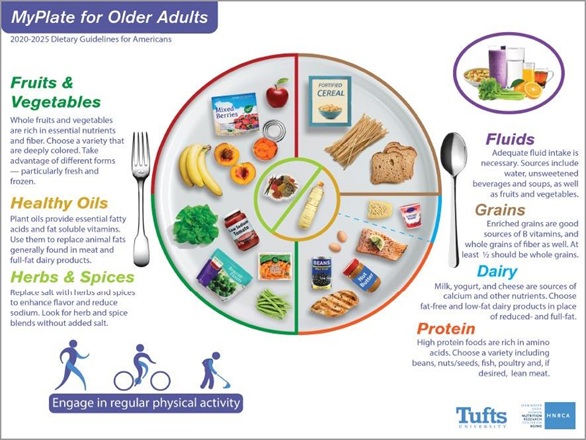
MyPlate for Older Adults
Healthy Oils- Plant oils provide essential fatty acids and fat soluble vitamins. Use them to replace animal fats generally found in meat and full-fat dairy products.
Herbs and Spices- Reduce salt with herbs and spices to enhance flavor and reduce sodium. Look for herb and spice blends without added salt.
Fluids- Adequate fluid intake is necessary. Sources indude water, unsweetened beverages and soups as well as fruits and vegetables.
Don't forget to engage in regular physical actvity!
- MyPlate for Older Adults
Published by:
Kelley, CJ., 2025, Healthy LIVING while aging! (2025-03), Extension | University of Nevada, Reno, Newsletter
An EEO/AA Institution. Copyright © 2026, University of Nevada Cooperative Extension.
A partnership of Nevada counties; University of Nevada, Reno; and the U.S. Department of Agriculture