While the Mojave Desert is not an inherently hospitable environment for fruit trees and vegetable crops, many varieties can thrive and produce substantial yields when provided with appropriate preparation, irrigation and maintenance. The University of Nevada, Reno Extension Botanic Gardens in Las Vegas maintains a long-term observational trial designed to identify fruit trees and vegetable cultivars that are both productive and resilient under southern Nevada conditions.
Crop production in the Mojave Desert is constrained by limited water availability, extreme summer temperatures, the urban heat island effect and poor native soils. As a result, successful cultivation requires soil amendment, efficient irrigation, appropriate pruning and fertilization practices. Equally important is the selection of cultivars that have demonstrated adaptability to these environmental stressors.
This annual report summarizes yield data collected during the 2024–2025 growing season from selected peach, nectarine and fig cultivars grown at the Extension Botanic Gardens. The findings highlight high-performing cultivars to guide local growers in selecting productive fruit tree cultivars suitable for the Mojave Desert.
Methods
Fruit tree cultivars selected for drought tolerance were maintained year-round using best management practices, including soil amendment, proper irrigation, seasonal pruning and fertilization. Harvested fruit was collected by staff and trained volunteers during peak harvest periods. Yields were weighed in pounds at the time of harvest.
For each cultivar, total yield was recorded as the combined harvest from one or more trees (replicates). Because the Gardens do not contain the same number of trees for each cultivar, the results in this paper standardize the findings to yield per replicate (yield per one tree) of the specified cultivar.
Results
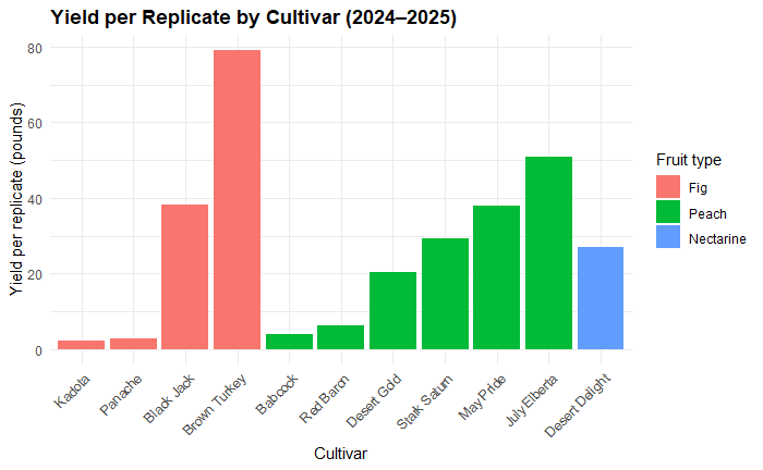
Figure 1. Yield per replicate (pounds per tree) for selected peach, nectarine and fig cultivars grown at the Extension Botanic Gardens.
Fruit yield varied widely among cultivars and fruit types during the 2024–2025 growing season (Figure 1). When standardized to yield per replicate (pounds per tree), fig cultivars exhibited the greatest range in productivity. 'Brown Turkey’ fig produced the highest yield per tree (79.1 lbs.), while ‘Black Jack’ produced a moderate yield (38.2 lbs.). In contrast, ‘Panache’ and ‘Kadota’ figs yielded less than 3 lbs. per tree.
Peach cultivars displayed substantial variability in yield per tree. ‘July Elberta’ produced the highest yield among peaches (50.8 lbs. per tree), followed by ‘May Pride’ (37.8 lbs.) and ‘Stark Saturn’ (29.4 lbs.). Lower yields were observed for ‘Desert Gold’ (20.4 lbs.), Red Baron’ (6.2 lbs.), and ‘Babcock’ (4.0 lbs. per tree).
The nectarine cultivar evaluated, ‘Desert Delight,’ produced 27.1 lbs. per tree, placing it within the mid-range of peach yields observed in this study.
Though results were standardized to yield per one replicate, for reference, the cultivars and their replicates in the Gardens are as follows: ‘Kadota’ (1), ‘Panache’ (1), ‘Black Jack’ (1), ‘Brown Turkey’ (1), ‘Babcock’ (6), ‘Red Baron’ (3), ‘Desert Gold’ (1), ‘Stark Saturn’ (2), ‘May Pride’ (1), ‘July Elberta’ (1), and ‘Desert Delight’ (2).
Yield data were combined across replicates, and individual tree-level measurements were not recorded, so inferential statistical analyses were not conducted. These results are descriptive but provide preliminary observations that may still inform local growers about productive cultivars suitable for the Mojave Desert.
Discussion
Yield data from the 2024-2025 growing season demonstrate substantial variation in productivity among fruit tree cultivars grown under Mojave Desert conditions. When yields were standardized on a per-tree basis, peaches demonstrated more consistency than figs. Peach cultivars showed a wide range of yields, with ‘July Elberta’ and ‘May Pride’ performing particularly well relative to other peach varieties evaluated. The nectarine cultivar ‘Desert Delight’ produced yields comparable to mid-performing peach cultivars, indicating that nectarines may be a viable option for growers seeking alternatives to traditional peach varieties.
Continued multiyear monitoring with increased replication and tree-level yield measurements will improve the ability to quantify variability and refine cultivar recommendations for desert growers. Extension encourages the public to visit the Botanic Gardens and consult with horticulture faculty and staff for further information.
Acknowledgements
Thank you to the Master Gardeners and other volunteers who assist staff and faculty with this ongoing research project.
For the complete paper in PDF form, please use the link below.