Managing Squarrose Knapweed
Introduction
Squarrose knapweed, of the sunflower (Asteraceae) family, is a noxious weed in Nevada. This competitive weed was introduced from Eurasia. It is not yet widely established in the west, but it has been found in Nevada. Nevadans must be vigilant to prevent its spread and establishment in Nevada’s dry rangelands and waste areas.
Identification
Squarrose knapweed (Centaurea virgata) is a true perennial that grows one to three feet tall. Its woody crown forms one or more clusters of rosette leaves formed on a stout taproot (Fig. 1). Profusely branched stems grow from each crown (Fig 2). The lower or basal leaves are stalked and deeply lobed. The upper stem leaves, however, are stalkless with fewer lobes on leaves near the end of the stems. Its upper leaves are bract-like, and the lower leaves often wither by the time flowering occurs.
The flower heads, which are smaller than those of other knapweeds found in the western United States, are produced individually or in pairs at the tips of the branches from June to August. Each flower head includes four to eight rose-purple or pink flowers (Fig. 1). The surrounding bracts have a terminal spine that is longer and stouter than the lateral spines. The tip of the bract generally curves backward toward the base of the flower, or spreads outward. While the shapes of the flower heads and bracts are similar to those of diffuse knapweed, squarrose knapweed heads have a more slender urn shape. Squarrose knapweed flower heads usually contain one to four golden to dark brown seeds, though empty seed heads are common. Unlike diffuse knapweed, squarrose knapweed seedheads are deciduous and fall off the stems soon after the seeds mature. The seeds are 3/16 to ¼ inch long. This includes a whitish plume of hair, which may be ⅓ the length of the seed, or not present at all. The seeds have dim linear stripes and an oblique scar where they disconnect from the head.
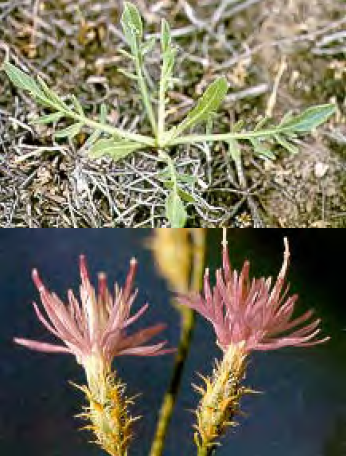
Figure 1. Squarrose knapweed seedlings have deeply-indented leaves (top). The pinkish flowers have recurved bract tips (bottom).
Habitat
Knapweeds readily grow on any disturbed soil, and their early spring growth makes them tough competitors for soil moisture and nutrients.
Squarrose knapweed is less widespread than other knapweeds, with limited distribution in Utah, Oregon, California, Wyoming, and Michigan. It has been found growing in White Pine County, Nevada. Most likely it is more prevalent than reported due to its close resemblance to the widespread diffuse knapweed with which it is often confused.
Squarrose knapweed prefers dry, open rangeland with shallow soils. Areas most susceptible are sagebrush and pinion-juniper rangelands. It readily invades and becomes established on rangelands with little herbaceous understory and even in crested wheatgrass seedings, particularly after fire. It can survive harsh climates, and is tolerant of fire and drought. This weed is rarely found on croplands or irrigated pasture because it cannot survive cultivation or excessive moisture from irrigation.
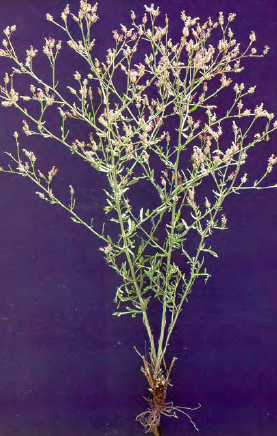
Figure 2. Abundantly branched stems grow from the squarrose knapweed’s crown.
Impact
Like other knapweeds, squarrose knapweed competes with forage species on rangeland and reduces forage production for livestock and wildlife. Squarrose knapweed has the potential to become an enormous problem weed in Nevada. Its unique means of dispersal facilitates its spread to new areas. The flower heads of squarrose knapweed function like burs clinging to passing animals. Sheep wool is perfect for catching and holding the bur-like heads, but other animals may carry the seeds. Seeds are also dispersed by vehicles, trains, and all types of equipment.
Management Methods
Prevention
Knapweeds reproduce by seed, so it is important that the spread of their seed be limited as much as possible. Do not drive vehicles through infested areas. Nearly 2,000 seeds may be caught underneath a vehicle after driving through just one patch of knapweed, and up to ten percent of those can still be on the vehicle ten miles down the road. If you drive through an infested area, be sure to immediately and thoroughly clean the underside of your vehicle.
Do not graze livestock during flowering and seeding of the weeds. Avoid moving stock from muddy, weed infested fields to uninfested areas as seeds clinging to muddy hooves and hides will spread the infestation. Always use hay that is free of knapweed seeds.
Squarrose knapweed closely resembles diffuse knapweed. It is important to frequently monitor rangelands and other properties for invasive weeds in order to detect their presence early, before they become well established. Monitor at least yearly, quarterly during the growing season is better. Detect and eradicate weed introductions early, minimize soil disturbance, and contain neighboring infestations quickly. It is essential to control outlying plants before attacking larger populations.
Mechanical Control
Hand pulling squarrose knapweed is ineffective because stout taproots resprout when broken off. Grubbing or digging the roots of individual plants or small infestations of squarrose knapweed with a shovel may be effective if most of the taproot is removed. The root should be cut at least eight inches below the soil surface in order to prevent the formation of new shoots.
Cultural Control
If desirable perennial grasses are abundant enough to provide competitive stress in knapweed stands, a careful application of a broadleaf herbicide that does not harm grasses may allow the grasses to effectively exclude the weeds. If timed correctly, precipitation or irrigation (where available) encourage growth of competitive grasses over squarrose knapweeds.
Biological Control
A variety of biological control agents have been released for control of knapweeds, and several of them have accepted squarrose knapweed as a host plant. The biological control agents may reduce seed production and stress the plant, thereby reducing the competitiveness of knapweeds. The effectiveness of biologicals on the whole infestation is minimal unless used in combination with other control methods.
The larvae of the broad-nosed seed head weevil, Bangasternus fausti, mine through the leaves and stems to the flower buds where they eat 95 percent of the seeds. Adults overwinter in the seedhead or in the duff at the base of the plants and are active May through July mating and laying eggs.
The gall-forming flies Urophora affinis and U. quadrifasciata, can substantially reduce seed production of squarrose knapweeds, and are widespread in Utah and California. The flies have not, however, had a great effect on knapweed populations because of the high number of seeds produced per plant.
The gray-winged root moth (Pterolonche inspersa) larvae feed on the roots of squarrose knapweed, pupate in mid-July and adults emerge to mate and lay eggs in late July and August.
Larvae of a buprestid beetle (Sphenoptera jugoslavica) feed on roots of squarrose knapweed. Chaetorellia acroplophi, a seedhead fly, appears to feed on squarrose knapweed, but has only established on other knapweeds to date.
Chemical Control
Control of squarrose knapweed with herbicides appears to be more difficult than other knapweeds but can be obtained if used in combination with other control methods. Annual treatments for several years will be needed because plants often regrow after chemical application. In addition, seed from previous years insures an available seed source to reestablish the infestation unless they are controlled as they germinate. Establishing a competitive crop or a sod of perennial grass will enhance control of regrowth and deter the establishment of new seedlings.
Glyphosate kills knapweed plants, but will also destroy competitive grasses. When using glyphosate, apply to actively growing plants in the bud stage at a rate of 3 lb ae/A. Seed a locally adapted perennial grass in the fall and at least ten days after the application.
Applying Tordon® (picloram) to knapweed plants in late spring before or during flower stem elongation at a rate of 0.25 to 0.5 lb ae/A will provide some control and will not damage perennial grasses. Treatment of plants in the bud stage may not prevent seed production in the year of application, but seed germination will be noticeably reduced. Tordon® is a restricted-use herbicide that must be applied by, or its application supervised by, a certified pesticide applicator.
Treating knapweed with 2,4-D will only control plants emerged at the time of application and often only the above ground parts, not the roots. 2,4-D should be applied in the early stage of flower stem elongation at a rate of 1 to 2 lb ae/A to be most effective. It usually does not kill existing squarrose knapweed plants, but helps prevent seed production.
After most rosettes have emerged, but before flower stems elongate, knapweeds can be treated with 2 to 5 quarts/A of Curtail® (clopyralid plus 2,4-D amine).
Stinger® (clopyralid) or Transline® (clopyralid) can be applied to knapweeds up to the bud stage of growth. The best results will be obtained if actively growing weeds are treated. The recommended rate of application for knapweeds is 0.25 to 0.5 lb ae/A.
Summary
Squarrose knapweed is an invasive, noxious weed that should be prevented from invading lands in Nevada. It can be successfully manage over time using a variety of integrated measures if addressed in an aggressive, consistent manner using the best knowledge about available control methods.
References
- Ball, D.A., D. Cudney, S.A. Dewey, C.L. Elmore, R.G. Lym, D.W. Morishita, R. Parker, D.G. Swan, T.D. Whitson and R.K. Zollinger. Weeds of the West. 9th edition, Western Society of Weed Science, 2001.
- Lacey, C.A., J.R. Lacey, P.K. Fay, J.M. Story, and D.L. Zamora. Controlling Knapweed on Montana Rangeland. Montana State University Extension Service. July 1999.
- Moser, L. and D. Crisp. Knapweed Information Page. San Francisco Peaks Weed Management Area. 18 Feb. 2004.
- Rees, N.E., P.C. Quimby, Jr., G.L. Piper, E.M. Coombs, C.E. Turner, N.R. Spencer and L.V. Knutson, eds. Biological Control of Weeds in the West. Western Society of Weed Science, Bozeman, MT, 1996.
- Sheley, R.L., and J.K. Petroff, eds., Biology and Management of Noxious Rangeland Weeds. Corvallis, OR, Oregon State University Press, 1999.
- William, R.D., A.G. Dailey, D. Ball, J. Colquhoun, T.L., Miller, R. Parker, J.P. Yenish, T.W. Miller, D.W. Morishita, P.J.S. Hutchinson, and M. Thompson. Pacific Northwest Weed Management Handbook. Corvallis, OR: Oregon State University, 2003.
- Photographs are courtesy of Weeds of the West.
Published by:
Graham, J. and Johnson, W., 2004, Managing Squarrose Knapweed, Extension | University of Nevada, Reno, FS-04-38
An EEO/AA Institution. Copyright © 2026, University of Nevada Cooperative Extension.
A partnership of Nevada counties; University of Nevada, Reno; and the U.S. Department of Agriculture