Statewide 4-H Service Project
Calling all 4-H members, volunteers, families, staff, alumni and friends!
Help the Nevada 4-H Youth Development program donate 5,000 face masks to communities across the state! If you are interested in helping with this effort, please contact your county 4-H staff member via email to let them know. They will share with you where to drop off the completed masks for distribution in your county. If you do not know the email address of your county 4-H staff person, it can be found at in the Extension directory (see below for links). If you are unable to get ahold of your county, you can contact Sarah Chvilicek (sarahc@unr.edu) for Northern Counties and Nora Luna (lunan@unr.edu) for Southern Counties to participate.
Also, as you donate masks, please record your donation at, 4-H Facemask Donation Survey. You can also share photos on social media with #Nevada4-HService
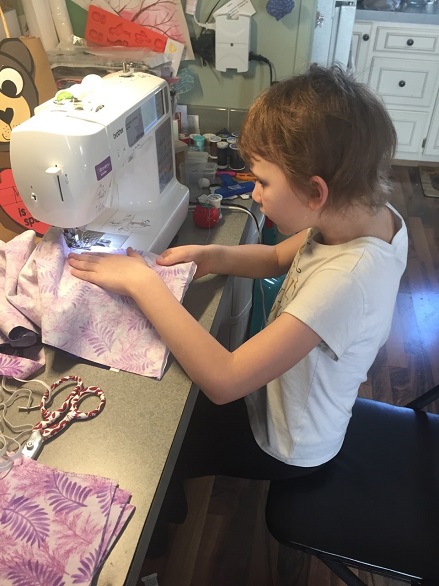 We have included some resources on how to make facemasks. If you have a different pattern, that is fine but please make sure that you follow the CDC guidelines in making those masks.
Resources:
- CDC Guidelines for Face Coverings
- Face Mask Directions
- Joann Fabric and Craft Store Directions
- No-Sew Mask Patterns
- Construction of Homemade Fabric Face Covering/Mask
- Textiles Used in Homemade Fabric Face Covering/Mask
- Layers are Important in Homemade Fabric Face Covering/Mask
- Proper Fit of Homemade Fabric Face Covering/Mask
- The Caring and Wearing of Homemade Fabric Face Coverings/Masks
- DIY Face Coverings/Masks Playlist
Plans and Programs:
- Joann Fabrics Make-to-Give Facemask Program
- Wisconsin 4-H Youth Development Cloth Face Coverings Service Learning Activity Plan
Additional information:
Mask Donation Card: Attached below
- 4-H Facemask Donation Survey
Please Note:
As you prepare to participate in this service activity, please keep in mind the CDC recommendation on use of homemade cloth face coverings. The Centers for Disease Control (CDC) recommends wearing cloth face coverings in public places where it’s hard to follow social-distancing recommendations. Examples include grocery stores and pharmacies. This practice is especially important where community spread is happening. CDC says that the use of simple cloth face coverings helps to slow the spread of the virus. Wearing these face coverings helps prevent those who do not know they have the virus from transmitting it to others. Voluntarily wearing cloth face coverings made at home is one-way people can help everyone when they need to go to public places. Cloth face coverings should not be put on young children under age 2. Also avoid putting them on anyone who has trouble breathing, or is unconscious, incapacitated or otherwise unable to remove the face covering without assistance. The cloth face coverings recommended are not surgical masks or N-95 respirators. Those are critical supplies, reserved for healthcare workers and other medical first responders, as recommended by current CDC guidance. (Guidance current as of April 5, 2020)
As a reminder, face coverings do not replace recommended prevention strategies including 6-feet social distancing, good hand hygiene, covering mouth and nose when you cough or sneeze, and cleaning high-touch surfaces. Please continue these and other recommended prevention practices even when face coverings are used.
We have made a template for small cards to put into the baggies with face masks we are providing to our communities. The template for you to download and print at home is available at the link below reading “Printable Version.” If you can, please print and include these cards with our donated masks. We also ask that you keep track of the number of masks that you provide and relay that information to your local 4-H staff member, so that we can see if we reach our goal!
Published by:
Stark, C, 2020, Statewide 4-H Service Project, Extension, University of Nevada, Reno
An EEO/AA Institution. Copyright © 2026, University of Nevada Cooperative Extension.
A partnership of Nevada counties; University of Nevada, Reno; and the U.S. Department of Agriculture