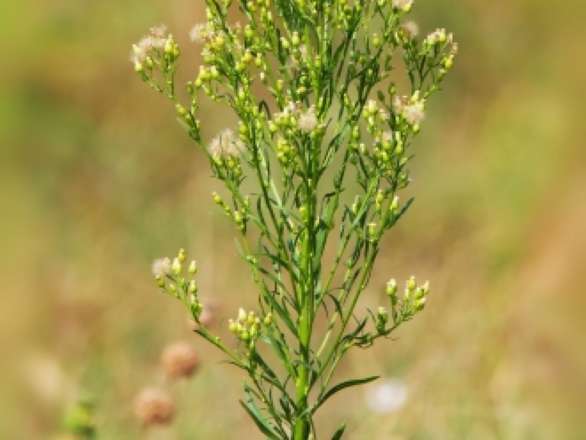
Recently, a producer came to my office with a photograph on his phone. He was concerned because the weed in his field seemed to be multiplying rapidly. When I visited the field, I found horseweed. The concern was justified because what looks like a few upright plants in late summer can become a much larger patch after those plants release seed. Horseweed does not spread through creeping roots or underground stems. It spreads by producing many very small seeds, each fitted with light bristles that help it travel on the wind. That biology explains why the producer could see the population increase so quickly and why the best time to act is before the seedheads become fluffy.
Is horseweed one weed or several?
Horseweed, Canadian horseweed, Canada fleabane, and marestail usually refer to the same species, Erigeron canadensis. Many weed guides and research papers still use the synonym Conyza canadensis. These are different names for the same plant, not separate types of horseweed. Hairy fleabane, Erigeron bonariensis (often listed as Conyza bonariensis), is a related but separate species that can be mistaken for horseweed. Hairy fleabane is usually grayer, more densely hairy, shorter, and more branched near the base. Horseweed is generally darker green, taller, and built around one main stem that branches mostly in the upper half. Seedlings can be difficult to separate, so use several features together.
Fall-emerging and spring-emerging horseweed are also not different types. They are the same species following two seasonal patterns. Fall seedlings remain as low rosettes through winter, while spring seedlings spend less time as rosettes before the central stem begins to elongate. This extended emergence period is one reason that a single scouting trip or control treatment may miss part of the population.
How can you recognize horseweed?
Look at the whole plant and its growth stage. Common features include:
- A low basal rosette when young, with hairy, narrow to club-shaped leaves that may have shallow teeth;
- One upright central stem after bolting, usually unbranched low on the plant and branching higher up;
- Many narrow, alternate leaves crowded along the stem;
- Numerous tiny flower heads on upper branches, with small white rays and yellowish centers; and
- Small, fluffy seedheads that resemble miniature dandelion puffs when mature.
Mature plants can vary greatly in height because moisture, competition, mowing, and other disturbances affect their form. A cut horseweed plant may branch from near the base and no longer show the usual single-stem shape. Therefore, do not rely on height or one leaf alone.
Why can a small patch spread so quickly?
Horseweed reproduces only by seed, but it can produce seed in large numbers. Extension sources report that a well-grown plant may produce more than 200,000 seeds. In field experiments in Illinois and Tennessee, estimated average production was about 122,178 and 94,146 seeds per plant, respectively. The exact number in a Nevada field will depend on plant size, moisture, competition, and when the plant emerged. The practical point is that even one mature escape can supply a large amount of seed.
Each seed carries a pappus, a tuft of fine bristles that functions like a small parachute. In one field study, researchers detected horseweed seed hundreds of yards downwind and collected seed 80 to 100 meters above the ground. Most seed settles closer to the source, but a small portion can move far enough to enter neighboring fields and properties. Dry, windy late-summer conditions can favor both release and transport.
The seed is also biologically ready to take advantage of open ground. It germinates best at or near the soil surface, often in disturbed, sparsely covered areas. Most horseweed seed is relatively short-lived compared with the seed of some other weeds, and many sources place its useful soil life at about two to three years. That is encouraging, meaning that if you prevent new seed and keep finding the next flush, the seedbank can decline.
How does horseweed reach a field?
Wind is the main pathway. A new patch does not necessarily mean that seed was produced in that exact spot the previous year. Seed may arrive from a field edge, ditch bank, roadside, fallow area, or another property. Water and farm equipment can also move seed, but for horseweed the feathered seed and wind are usually the larger part of the story.
Once horseweed establishes, local seed production becomes the part you can control most directly. Scout the original patch and the surrounding area, including fence lines, irrigation banks, field entrances, equipment parking areas, and bare or thin portions of the crop. Clean plant material and soil from equipment before moving from an infested area to a clean field.
Why does horseweed deserve attention in Nevada?
Horseweed is native to North America, and it is not included on the current Nevada noxious weed list. That legal status should not be confused with its effect in a production field. A native plant can still be a serious agricultural weed when it competes with a crop, occupies thin forage stands, or repeatedly seeds disturbed ground.
Horseweed grows rapidly and competes strongly for water. That matters in Nevada, where a weed using limited soil moisture is competing with the crop or desirable forage you intended to support. It can also form dense stands in bare areas and is often more troublesome where crop residue or other plant cover is limited.
Herbicide resistance adds another reason for early attention. Horseweed populations resistant to glyphosate and several other herbicide groups have been documented in the United States. That does not prove that the horseweed in this Nevada field is resistant. A control failure may also reflect plant size, poor coverage, weather, timing, or an unsuitable product. It does mean that relying on the same herbicide year after year is not a sound long-term plan.
What should you do when you find it?
- Confirm the plant and mark the patch: Record whether plants are rosettes, bolting, flowering, or already fluffy with seed. Map the patch and scout beyond the obvious plants. Related fleabanes and other members of the sunflower family can look similar, particularly when young.
- Remove isolated plants before seed release: Pull or dig small infestations when the soil allows the root to come out cleanly. If flower or seedheads are present, handle the plant gently, contain it in a bag, and remove it from the production area. Do not shake mature plants or carry uncovered seedheads across a clean field.
- Use mowing at the right stage and return afterward: Mowing during the bud stage can help in pastures, roadsides, and other suitable noncrop areas. Mowing late or only once can leave plants that branch near the base and flower below the original cutting height. Recheck the site and prevent regrowth from producing seed.
- Keep useful plants or residue covering the soil: A competitive crop or forage stand, retained residue, and a well-managed cover crop can reduce the light and open space that horseweed seedlings need. In a row-crop study, fall-planted cover crops greatly reduced horseweed density before spring termination, although cover crops were not a complete season-long control by themselves.
- Use tillage only where it fits the production system: Tillage can uproot rosettes and bury the tiny seed too deeply to emerge, but it also carries costs. In Nevada's water-limited soils, unnecessary or repeated tillage can increase erosion, lose moisture, and disturb soil structure. Weigh those tradeoffs rather than treating tillage as a universal answer.
- If you use an herbicide, treat small plants and match the label to the site: Horseweed is easiest to control as a seedling or rosette and becomes harder once the stem elongates. Product choice depends on the crop, pasture, orchard, or noncrop site; plant size; resistance history; and current label. Do not assume that glyphosate alone will control every population. Rotate effective sites of action and combine chemical control with other practices. Follow all grazing, haying, preharvest, planting, and water-use restrictions. Never apply a product to an irrigation ditch or water body unless the label explicitly allows that use.
- Return in fall and again in early spring: Horseweed can emerge in both seasons, and wind can bring new seed even after you clean up the original patch. Continue checking the mapped area for at least the next two to three years and remove escapes before they replenish the seedbank.
A few cautions that matter
- Do not count on grazing as the control program: Horseweed is generally not preferred by livestock, and Montana guidance notes that its irritating defensive chemicals make grazing unreliable as a management tool. Maintain desirable forage competition and use a planned control approach instead.
- Do not confuse a legal list with a field recommendation: Horseweed is not currently a Nevada-listed noxious weed, but a rapidly expanding patch in a crop, pasture, orchard, or irrigation corridor still deserves attention.
- Do not diagnose resistance from one failed treatment: Document the product, rate, plant size, weather, and application conditions, then consult an Extension educator, crop adviser, or licensed pesticide professional. Increasing a rate beyond the label is illegal and may injure the crop or environment without solving the problem.
References and additional resources
- Fine, T., McKenzie, S. C., Chen, C., & Menalled, F. D. (2016, May). Biology, identification, & management of glyphosate-resistant horseweed (marestail, Conyza canadensis) (MT201608AG). Montana State University Extension. https://extension-store.montana.edu/montguides/biology-identification-management-of-glyphosate-resistant-horseweed-marestail-conyza-canadensis
- Heap, I. (2026). The International Herbicide-Resistant Weed Database. Retrieved September 16, 2026, from https://www.weedscience.org/
- Liu, J., Zhao, Q., & Huang, H. (2022). Dynamic seed emission, dispersion, and deposition from horseweed (Conyza canadensis (L.) Cronquist). Plants, 11(9), Article 1102. https://doi.org/10.3390/plants11091102
- Nevada Department of Agriculture. (n.d.). Nevada noxious weed list. Retrieved September 15, 2026, from https://agri.nv.gov/plant/noxious_weeds/noxious_weed_list/
- Pittman, K. (n.d.). Horseweed (marestail). GROW: Getting Rid of Weeds Through Integrated Weed Management. Retrieved September 15, 2026, from https://growiwm.org/weeds/horseweed-marestail/
- Pittman, K. B., Barney, J. N., & Flessner, M. L. (2019). Horseweed (Conyza canadensis) suppression from cover crop mixtures and fall-applied residual herbicides. Weed Technology, 33(2), 303–311. https://doi.org/10.1017/wet.2018.111
- Royal Botanic Gardens, Kew. (n.d.). Conyza canadensis (L.) Cronquist. Plants of the World Online. Retrieved September 15, 2026, from https://powo.science.kew.org/taxon/urn:lsid:ipni.org:names:64815-2
- University of California Statewide Integrated Pest Management Program. (2025a, November). Hairy fleabane. University of California Agriculture and Natural Resources. https://ipm.ucanr.edu/weeds-identification-gallery/hairy-fleabane/
- University of California Statewide Integrated Pest Management Program. (2025b, November). Horseweed. University of California Agriculture and Natural Resources. https://ipm.ucanr.edu/weeds-identification-gallery/horseweed/