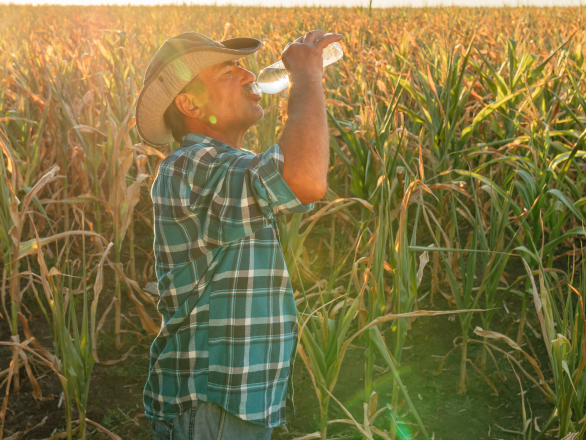
 In Nevada and across the interior West, heat is not just uncomfortable weather. It is a field-work hazard, a public-health concern, and an occupational safety issue that deserves the same planning attention as irrigation timing, pesticide safety, livestock handling, and road travel. As Extension professionals, we often meet producers, families, youth, volunteers, and community partners in fields and rangeland settings. Because we serve people who work and live in hot, dry, windy, and sometimes remote environments, we must model the same heat-safety practices that we recommend to farmers and the public. We also want to inform farmers and ranchers about recent changes to Nevada OSHA’s regulation on heat-related illnesses.
The State of Nevada Department of Business and Industry, Division of Industrial Relations, Occupational Safety and Health Administration updated their guidance for Regulation R131-24AP: Heat Illness Prevention on May 21, 2026. This updated guidance reflects the Nevada OSHA enforcement practices of the Federal OSHA Outdoor and Indoor Heat-Related Hazards National Emphasis Program (NEP). Businesses with more than 10 employees are required to conduct a heat-illness hazard assessment and establish a written safety program for prevention of heat illnesses. All industries, including agriculture and natural resources management, that are subject to Nevada OSHA jurisdiction (NRS 618.315 (2)) must comply. Household domestic service, motor vehicles on public highways, and mining facilities are excluded from these regulations. To meet these new regulations, we will provide definitions and information about heat-related illness, describe best practices for preventing heat-related illness, and share a template for a hazard analysis and safety plan for agricultural and other outdoor businesses.
Because this article is intended for both UNR/Extension personnel and our clientele, readers should distinguish between public-facing heat-safety guidance and employer compliance obligations. UNR employees should also consult the UNR Environmental Health and Safety (EH&S) Heat Illness Prevention Program, which applies to employees who may be exposed to indoor or outdoor working conditions that create a reasonable likelihood of heat illness and assigns supervisors responsibility for Job Hazard Analysis (JHAs), protective measures, employee training, and a designated person for monitoring and emergency response. Because Nevada OSHA issued updated guidance in May 2026, UNR units should verify current internal implementation with EH&S before using this article for training or compliance documentation.
University of Nevada, Reno Extension identifies heat rash, heat syncope, heat cramps, heat exhaustion, and heat stroke as major heat-stress conditions. While older adults, people with chronic diseases, and those taking certain medications are at greater risk during extreme heat exposure, heat-related illness can affect anyone, including otherwise healthy young and middle-aged workers.
For agricultural and outdoor workers, the risk is intensified by direct sun exposure, physical exertion, equipment operation, limited shade, personal protective equipment, long workdays, and the pressure to complete irrigation, harvest, planting, spraying, livestock, or repair tasks within narrow time windows. A National Institute for Occupational Safety and Health (NIOSH)-linked agricultural safety review reported that crop workers experienced a heat-related fatality rate approximately 20 times higher than the overall U.S. civilian worker rate, making clear why heat prevention must be treated as a core farm-safety issue rather than an optional summer reminder.
Heat risk is created by the interaction of four main factors: weather, workload, clothing or protective equipment, and individual health status (which can be influenced by acclimatization and many other factors). In Nevada’s desert and semi-arid environments, low humidity can make sweat evaporate quickly, which helps cool the body but can also hide how much water and electrolytes are being lost. NIOSH explains that sweating cools the body through evaporation, but sweating also removes water and electrolytes; when water intake does not keep up with loss, dehydration increases the risk of heat illness. Therefore, waiting until a person feels thirsty, dizzy, weak, or confused is not a safe heat-management strategy.
Heat safety begins before leaving the office or house
The first precaution is planning, and Extension personnel, farm managers, crew leaders, producers, volunteers, and family members should check heat forecasts before scheduling field visits, farm tours, outdoor meetings, volunteer workdays, demonstrations, pesticide applications, irrigation repairs, or strenuous home-garden tasks. The National Weather Service HeatRisk tool provides a color and numeric forecast to help identify the level of heat concern and the groups most likely to be affected, and it is useful for planning several days ahead. The Occupational Safety and Health Act (OSHA)-NIOSH Heat Safety Tool app can also help workers and supervisors use local weather conditions and hourly heat-index forecasts to plan work, breaks, and precautions.
In addition to the National Weather Service forecast products, CDC’s Heat and Health Tracker and CDC HeatRisk resources can help public-health planners and Extension staff visualize heat-related illness risk, recent heat conditions, and community vulnerability. When a dashboard product is unavailable, the National Weather Service HeatRisk forecast and local National Weather Service heat advisories should remain primary planning tools for field visits, trainings, and public events.
For Extension programming, heat planning should be built into the agenda. Farm walks, field demonstrations, scouting visits, and outdoor workshops should be scheduled in the morning whenever possible. If an event must occur during a hot period, the agenda should include shorter field segments, shaded stops, water stations, cooling breaks, and a clear plan for moving participants indoors or into air-conditioned vehicles. The host, organizer, and speakers should know the exact field address or GPS location, the closest road access point for emergency responders, and who will call 911 if needed.
For producers and farm supervisors, heat planning should be part of the daily tailgate meeting. Crews should know the forecast, the day’s highest-risk tasks, water locations, shade or cooling locations, rest-break expectations, emergency contacts, and symptoms that require immediate action. In Nevada, employers should also review Nevada OSHA's heat illness prevention guidance for Regulation R131-24AP. This guidance was recently updated in May, 2026. Nevada OSHA’s guidance states that covered employers with more than 10 employees are required to establish a written safety program, and the heat-illness regulation includes requirements such as a written job hazard analysis, designation of a responsible person, protective measures, training, and reasonable mitigation of heat-related risk. Nevada OSHA also includes best practices in their document, which are recommendations, not regulations.
For covered Nevada employers, the JHA should not simply state that water, rest, and shade are available. Nevada OSHA instructs employers to assess heat exposure first, including air temperature, relative humidity, radiant heat, conductive heat, air movement, workload severity and duration, and protective clothing or PPE; access to water, rest, and shade should then be treated as mitigation measures. This distinction is useful for agricultural employers because irrigation repair, high-tunnel work, hay handling, livestock work, pesticide tasks, and equipment repair can involve different heat profiles even on the same day.
Water, rest, shade, and cooling are the foundation
The simplest heat-safety message remains one of the most important: water, rest, shade, and cooling. NIOSH recommends that workers doing moderate activity in moderate heat drink about one cup of water every 15 to 20 minutes and drink before becoming thirsty. An example can be drawn from California’s agricultural heat guidance, which provides a useful Western benchmark by requiring enough fresh water for each outdoor employee to drink at least one quart per hour and by emphasizing training, water, shade, and planning. While Nevada operations should follow Nevada requirements, this Western guidance is a practical reminder that water must be close, visible, cool enough to drink, and available before symptoms develop.
Breaks should not be treated as lost productivity but rather as a risk-control measure. Shade or cooling areas should be close enough that workers and participants actually use them. Another example is California’s heat guidance, which notes that shade should be available for outdoor workplaces when temperatures exceed 80°F and that high-heat procedures are needed when temperatures reach at least 95°F. For Nevada Extension events and farm operations, similar temperature thresholds can serve as planning triggers, even where the exact California rule does not apply. A practical approach is to increase rest frequency as heat rises, shorten outdoor talks, rotate heavy tasks, and move non-essential activities to cooler times of day or indoors.
Cooling should include shade, air conditioning, cooling towels, wet cloths, misting where appropriate, and access to cool indoor or vehicle spaces. However, fans are not always protective under very hot conditions. For example, Nevada Emergency Management cautions that fans may be useful when heat index values are below the high 90s, but they can make a person hotter at higher heat-index temperatures. In other words, air movement is not a substitute for hydration, shade, reduced workload, and active cooling during dangerous heat.
Heat exposure should also be evaluated in indoor or semi-enclosed areas that are not effectively climate-controlled, including high tunnels, greenhouses, barns, shops, packing areas, storage buildings, and vehicles or equipment cabs with failed air conditioning. Under Nevada OSHA guidance, non-climate-controlled indoor work is covered, and if climate control becomes nonfunctional or ineffective, employers must implement protective measures while making a good-faith effort to restore effective climate control.
Acclimatization matters, especially early in the season
Heat illness often occurs when people are not yet used to heat. This can happen early in summer, after a cool spell, after travel, after illness, or when a new worker begins outdoor work. NIOSH notes that acclimatization generally develops over 7 to 10 days of heat exposure, but heat waves can exceed a person’s ability to adapt quickly, requiring more breaks and rescheduling of harder tasks. Cal/OSHA guidance similarly emphasizes close observation of new or newly assigned workers during a 14-day acclimatization period and close observation during heat waves.
As Extension professionals and university educators, we should apply the same principle to ourselves. Returning from office work, travel, conferences, illness, or several days indoors and then jumping directly into long field visits, farm tours, or field-day setup can increase heat risk. Supervisors and event organizers should watch new employees, interns, students, volunteers, speakers, and visiting specialists who may not be acclimatized to Nevada heat.
Recognize symptoms early and respond quickly
Heat illness can progress quickly, as the Centers for Disease Control and Prevention (CDC)/NIOSH lists heat exhaustion symptoms such as headache, nausea, dizziness, weakness, irritability, thirst, heavy sweating, elevated body temperature, and decreased urine output. New Mexico State University Extension also emphasizes that dehydration and heat exhaustion often occur together, with signs such as dry mouth, thirst, dizziness, confusion, weakness, nausea, vomiting, and rapid heartbeat. These are warning signs to stop work, move the person to shade or cooling, provide water if the person is alert and able to drink, loosen unnecessary clothing, and monitor closely.
High-exertion work can also contribute to rhabdomyolysis, a serious muscle-breakdown condition. The Nevada Division of Forestry heat policy and JHA flag muscle pain, dark urine or reduced urine output, and weakness as warning signs; these symptoms should be treated as medical red flags, especially after strenuous work, heavy PPE use, firefighting, hay handling, fencing, digging, or prolonged work in the sun.
Heat stroke is a medical emergency for which the CDC/NIOSH identifies its signs, such as confusion, altered mental status, slurred speech, loss of consciousness, seizures, very high body temperature, and either hot, dry skin or profuse sweating. The old assumption that a heat-stroke victim will not be sweating is unsafe; exertional heat stroke can occur even when a person is still sweating. If heat stroke is suspected, call 911 immediately, move the person to a cooler or shaded area, remove outer clothing, and begin rapid cooling with cold water, wet cloths, ice packs, or an ice bath if available. Do not leave the person alone.
Extension professionals should model heat-safe outreach
Because Extension is often seen as a trusted field partner, our behavior communicates as much as our written recommendations. When we arrive at a farm visit with water, shade plans, realistic scheduling, and willingness to pause field discussion for participant safety, we normalize good heat practices. When we push through extreme heat without breaks, we unintentionally reinforce unsafe norms.
For Extension farm visits, staff should carry a heat kit that includes water, electrolyte options, a cooler, sunscreen, a wide-brim hat, light breathable clothing, a charged phone, a first-aid kit, cooling towels, and the site address or GPS location. For farm tours and field days, organizers should provide shade canopies or indoor cooling areas, water at multiple points, shorter outdoor teaching stops, and a designated safety lead. Registration materials should remind participants to bring hats, refillable water bottles, appropriate footwear, and any personal medications they may need. Where audiences include older adults, children, pregnant individuals, or people with chronic conditions, heat precautions should be stronger.
Remote field locations need a check-in and emergency-access plan. For a farm visit, rangeland stop, irrigation structure, demonstration plot, or field day at a remote site, the plan should include who has cell or satellite communication, the exact GPS/location description, where emergency responders can access the site, and what to do if a worker or participant does not respond to a check-in. Nevada OSHA’s guidance describes 30- to 60-minute status checks as a best-practice example for remote heat-exposed workers, with escalation procedures if the worker fails to respond.
Southern Nevada Health District emphasizes special precautions for pregnant people, infants, and children, noting that pregnant individuals are more likely to experience heat exhaustion, heat stroke, or other heat-related illness sooner than nonpregnant people, and that infants and children depend on others to keep them cool and hydrated. This is especially important for public Extension events, 4-H activities, school gardens, master gardener programs, farmers' markets, county fairs, and volunteer fieldwork.
Practical precautions for farmers, ranchers, and outdoor crews
Farm and ranch operations should develop a heat plan before the hottest part of the season. At minimum, that plan should identify who monitors weather, who supervises heat precautions, where water and shade are located, how breaks are scheduled, how new or returning workers are acclimatized, what symptoms require stopping work, and how emergency response will occur. Wet-bulb globe temperature (WBGT) is a frequently used value for judging the amount of environmental heat stress people are experiencing. There are approved instruments that can be purchased for monitoring WBGT, but in Nevada, the enforcement trigger for inspection will be based on “heat priority days,” defined as the days when temperature reaches or exceeds 90 degrees Fahrenheit.
The May 2026 Nevada OSHA NEP update is also important for agricultural and natural-resource employers because targeted non-construction industries include cattle ranching and farming, hog and pig farming, and support activities for crop production. The same NEP update states that Nevada OSHA will refer employers needing assistance to the Nevada Safety Consultation and Training Section (SCATS), which provides training, consultation, and safety-program review resources.
Heavy open-field tasks such as hay handling, irrigation repair, fencing, hand weeding, transplanting, harvest, livestock processing, and equipment repair should be scheduled for cooler hours when possible. When pesticides or other tasks require protective clothing, supervisors should recognize that personal protective equipment (PPE) can trap heat and reduce the body’s ability to cool. NIOSH lists personal protective equipment or clothing, direct sun, physical exertion, lack of air movement, dehydration, medications, health status, age, and lack of acclimatization among heat-illness risk factors. For pesticide-related work, follow the pesticide label and worker protection requirements, but also adjust timing, breaks, hydration, and monitoring to account for additional heat burden.
A buddy system is strongly recommended, and workers should be encouraged to speak up when they feel unwell and to watch coworkers for unusual behavior, stumbling, confusion, irritability, weakness, or slowed response. Supervisors should never send a symptomatic worker to drive alone, and persons with possible heat illness should be cooled, observed, and medically evaluated as needed.
Practical precautions for the public
Heat safety also applies to homeowners, gardeners, youth, older adults, outdoor recreationists, and community members attending Extension programs. People should schedule strenuous yard work, gardening, walking, or outdoor errands in the morning or evening, drink water regularly, wear light-colored loose-fitting clothing, use sun protection, and rest in shade or air conditioning when overheated. Southern Nevada Health District recommends drinking water regularly even when not thirsty, limiting alcohol, carrying water and a phone outdoors, avoiding peak heat hours, wearing lightweight, light-colored clothing and a hat, using sunscreen, checking on neighbors, and never leaving children or pets in vehicles.
Older adults, people with heart disease, diabetes, dementia, high blood pressure, poor circulation, obesity, or those taking certain medications should take special care. UNR Extension cautions that older adults may not sweat as effectively and may gradually lose the ability to feel thirst, increasing dehydration risk. Anyone with medical conditions or medications that may affect heat tolerance should consult a health professional before prolonged outdoor work during extreme heat.
A simple field-day and farm-visit heat checklist
Before the event or workday:
- Check the National Weather Service (NWS) HeatRisk and the OSHA-NIOSH Heat Safety Tool.
- Schedule outdoor work for cooler hours.
- Identify shade, cooling areas, restrooms, and water refill points.
- Bring more water than expected.
- Assign a heat-safety lead.
- Know the exact location for emergency response.
- Communicate expectations to speakers, staff, volunteers, and participants.
During the event or workday:
- Start hydrating before people feel thirsty.
- Encourage small, frequent water intake.
- Shorten field talks and rotate people through shade.
- Watch new workers, visitors, older adults, youth, and anyone doing strenuous tasks.
- Stop activity immediately if symptoms appear.
- Use the buddy system.
- Do not shame people for taking breaks.
After the event or workday:
- Review what worked and what did not.
- Record heat-related near misses.
- Adjust future scheduling, staffing, shade, and water supplies.
- Follow up with anyone who showed symptoms.
- Build heat planning into the next event, not just the next heat wave.
Where possible, keep the heat JHA, training roster, safety-plan template, emergency procedures, and event heat checklist together in the same event or work-unit file. For Extension programs, the same recordkeeping approach can support internal safety planning, post-event review, and future improvements.
Template for Outdoor Agriculture Heat-Illness Hazard Assessment
| Job Title |
Job Location |
Analyst |
Date |
| Farm/Ranch Hand |
Farm/Ranch/Allotment |
Hazard Type |
Consequence |
Task # 1
Animal care |
Task Description: Feed and care of animals, move to new pastures, maintain water sources, shoe horses, trim animal hooves, provide health procedures (vaccinate, treat, minor surgery, etc.) |
Hazard Description: Spending several hours outdoors in weather meeting or exceeding 90 degrees F. Some activities may be physically strenuous. |
Hazard Controls: Water and shade will be available, and rest breaks provided as needed. Acclimatization will increase from the first sign of hot weather for a period of 1-2 weeks.
|
Task #2
Irrigation |
Task Description: Monitor irrigation applications, fix ditches and gates, maintain and/or build pipelines, |
Hazard Description: Spending several hours outdoors in weather meeting or exceeding 90 degrees F. Some activities may be physically strenuous. |
Hazard Controls: Water and shade will be available, and rest breaks provided as needed. Acclimatization will increase from the first sign of hot weather for a period of 1-2 weeks.
|
Task #3
Collect rangeland data |
Task Description: Conduct plant studies, measuring plant height, weight, cover, hike or ride horses to remote sites, take pictures at photo points, maintain data |
Hazard Description: Spending several hours outdoors in weather meeting or exceeding 90 degrees F. Some activities may be physically strenuous. |
Hazard Controls: Water and shade will be available and rest breaks provided as needed. Acclimatization will increase from the first sign of hot weather for a period of 1-2 weeks.
|
Outdoor Agriculture Heat-Illness Prevention Plan
Safety in outdoor conditions and prevention of heat illness is important to our operation and to our employees. When “heat priority days” of 90 degrees F or more occur, it becomes especially important to follow procedures in this Heat-Illness Prevention Plan.
- Potable Water: Potable water is required in each vehicle in the amount of 32 oz or more per worker.
- Rest breaks and Cooling: If an employee exhibits signs or symptoms of heat illness, they are required to take a rest break. Breaks can include shading up, an air-conditioned vehicle, cooling towels, and water application to clothing and/or hats to help reduce body temperature. Employees can alter their breaks to incorporate more breaks or a lunch break during the hottest part of the day.
- If an employee exhibits signs or symptoms of heat illness, they will notify their supervisor or designated monitor, who will continue to monitor that person and/or assign other duties in cooler temperature settings.
- If working with engines, repair of equipment that is metal, generators, or other devices that expel additional heat, workers and the designated monitor will check in more frequently or take more rest breaks during heat priority days.
- Employees will be trained in heat illnesses, prevention, and mitigation. Employees will watch the following videos before commencing work each year during heat priority days: (1) What is Exertional Heat Illness? (2/10) - YouTube https://www.youtube.com/watch?v=v6gDjXz4y1Q; (2) Exertional Heat Injury Prevention & Treatment - YouTube https://www.youtube.com/watch?v=-yx19eXsO1Y, start at 1:55 min. This longer video is more helpful: https://www.youtube.com/watch?v=QXUOFMeapvM; (3) Rhabdomyolysis: What You Need to Know - YouTube https://www.youtube.com/watch?v=CuTcIq25964.
- Emergency procedures: the designated monitor will call 911 if heat stroke is suspected. If any heat-related illness is suspected, the designated monitor will assist the employee in reducing body temperature, either through moving to a cooler or shaded area, an air-conditioned vehicle, and/or icing and watering the body to reduce temperatures.
Training, documentation, and records
Training should be documented, not assumed. A useful heat-safety record should include the class title, date, instructor, materials used, training hours, participant names, signatures, and duty station or work unit. The Nevada Division of Forestry training roster provides this type of documentation structure, and SCATS offers Heat-Related Illness training covering the Federal OSHA NEP, Nevada OSHA heat illness letter, heat priority days, the National Weather Service, heat-stress recognition, hierarchy of controls, employee training, and prevention-program development.
Acknowledgements
The authors gratefully acknowledge Joseph A. “Andy” Giddings, Medical Safety Officer for Occupational Health with University of Nevada, Reno Environmental Health and Safety, for reviewing the technical content, sharing relevant heat-illness prevention resources, and providing valuable feedback that strengthened this publication.
References and Additional Resources
- American Medical Association. (2026, June 24). What doctors want patients to know about heat stroke. https://www.ama-assn.org/public-health/population-health/what-doctors-want-patients-know-about-heat-stroke
- California Department of Industrial Relations. (2024). Heat illness prevention guidance and resources. https://www.dir.ca.gov/dosh/heatillnessinfo.html
- California Department of Industrial Relations. (2024). Outdoor heat illness prevention. https://www.dir.ca.gov/dosh/heat-illness/outdoor.html
- Centers for Disease Control and Prevention. (2026a). Heat and Health Tracker. https://ephtracking.cdc.gov/Applications/heatTracker/
- Centers for Disease Control and Prevention. (2026b). HeatRisk. https://ephtracking.cdc.gov/Applications/HeatRisk/
- Centers for Disease Control and Prevention, National Institute for Occupational Safety and Health. (2026, March 3). Heat Safety Tool app (OSHA-NIOSH). https://www.cdc.gov/niosh/heat-stress/communication-resources/app.html
- Centers for Disease Control and Prevention, National Institute for Occupational Safety and Health. (2026). Heat-related illnesses. https://www.cdc.gov/niosh/heat-stress/about/illnesses.html
- Industrial Commission of Arizona. (n.d.). Heat illness prevention. https://www.azica.gov/heat
- Jackson, L. L., & Rosenberg, H. R. (2010). Preventing heat-related illness among agricultural workers. Journal of Agromedicine, 15(3), 200–215. https://stacks.cdc.gov/view/cdc/188356
- Koukel, S. (n.d.). Heat stress: Signs and prevention. New Mexico State University Extension. https://pubs.nmsu.edu/_i/I115/index.html
- Mazzullo, N. (2024). Heat illness and hydration. University of Nevada, Reno Extension. https://extension.unr.edu/publication.aspx?Pubtitle=6619
- National Institute for Occupational Safety and Health. (2011). Keeping workers hydrated and cool despite the heat. https://www.cdc.gov/niosh/bulletin/2011/heat2.html
- National Institute for Occupational Safety and Health. (2016). Criteria for a recommended standard: Occupational exposure to heat and hot environments (DHHS/NIOSH Publication No. 2016-106). https://www.cdc.gov/niosh/docs/2016-106/default.html
- National Weather Service. (2026). Heat forecast tools. https://www.weather.gov/safety/heat-tools
- Nevada Department of Business and Industry, Division of Industrial Relations, Occupational Safety and Health Administration. (2026a, May 21). Updated guidance for Regulation R131-24AP: Heat illness prevention. https://dir.nv.gov/uploadedFiles/dir.nv.gov/content/OSHA/Features/2026-05-21%20(Updated%20Heat%20Illness%20Prevention%20Guidance).pdf
- Nevada Department of Business and Industry, Division of Industrial Relations, Occupational Safety and Health Administration. (2026b, May 21). Indoor and outdoor heat-related hazard National Emphasis Program update. https://dir.nv.gov/uploadedFiles/dir.nv.gov/content/OSHA/Features/2026-05-21%20Guidance%20for%20Nevadan%20Businesses%20Related%20to%20Updated%20Indoor%20and%20Outdoor%20Heat%20Hazard%20NEP.pdf
- Nevada Department of Public Safety, Division of Emergency Management. (2025). Extreme heat. https://www.oem.nv.gov/emergency-management/threats-hazards/extreme-heat/
- Nevada Division of Forestry. (2022). Training attendance roster: Heat illness and rhabdo [Training roster].
- Nevada Division of Forestry. (2025a). Heat exposure and illness prevention policy [Policy document].
- Nevada Division of Forestry. (2025b). Job hazard analysis: Heat exposure and illness prevention [Job hazard analysis].
- Nevada Safety Consultation and Training Section. (2025, May 20). Heat illness prevention checklist. https://www.4safenv.state.nv.us/news/heat-illness-prevention-checklist/
- Nevada Safety Consultation and Training Section. (2026a). Occupational health and safety classes. https://www.4safenv.state.nv.us/training/classes/
- Nevada Safety Consultation and Training Section. (2026b). Safety training class descriptions: Heat-related illness. https://www.4safenv.state.nv.us/training/class-descriptions/
- Southern Nevada Health District. (2026). Beat the Heat Southern Nevada. https://www.southernnevadahealthdistrict.org/programs/beattheheatsnv/
- University of California Agriculture and Natural Resources. (n.d.). Heat illness prevention. https://ucanr.edu/site/division-agriculture-and-natural-resources/heat-illness-prevention
- University of Nevada, Reno Environmental Health & Safety. (2025, April 8). Heat illness prevention program. https://www.unr.edu/ehs/policies-manuals/heat-illness-prevention-program