Washoe County Master Gardener Newsletter (2026-06)
In this edition
- About This Newsletter
- A Note From the Editors
- Being Part of Something Bigger
- What's Happening This Summer
- A Tale of Too Many Crickets
- A Long Season of Bloom in a Shade Garden
- Gardening as a Tool for Mental Well-Being
- Growing Cilantro in a Warm Climate
- Remember the Water for the Fauna
- The Trials of Tomato Growing
- A Garden Showcase at Valley Wood Park
- MG Photo Submissions
- Gratitude: Talks in the Garden
- Creating a Pollinator-Friendly Garden
About This Newsletter
Welcome to our newsletter dedicated to gardening enthusiasts in Nevada! Here, the Master Gardener Volunteers of Washoe County are committed to fostering a community of gardening knowledge and education. Through this publication, we aim to provide research-based horticulture insights for our readers. Each quarter, we offer a wealth of information covering various aspects of gardening, from upcoming garden events to advice on topics ranging from pest control to sustainable gardening practices. Join us as we explore the science and artistry of gardening together!
A Note From the Editors
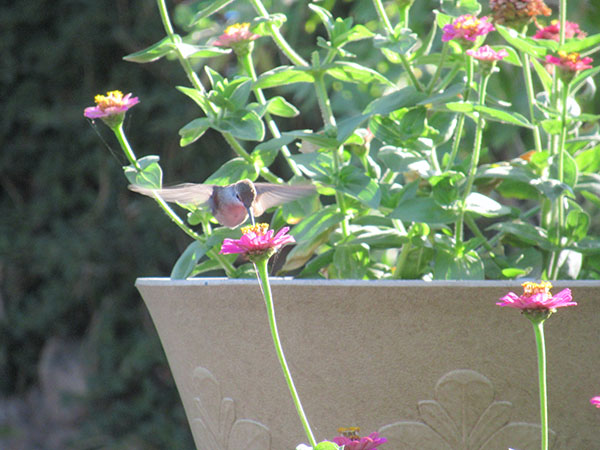
Hummingbird enjoying zinnia nectar.
Photo by Becky Colwell
It’s early summer, and time to prune your spring-flowering shrubs to ensure a great bloom next spring. The flower buds for shrubs like quince and lilac form on old wood, which starts growing soon after the shrubs have finished blooming in the current year. If you prune too late, you risk cutting off twigs and branches that will bear next year’s flowers.
If you left seed heads and spent foliage on perennials to help feed and shelter beneficials over the winter, it is now time to clean them up. During the growing and blooming season, regular removal of faded flowers, called deadheading, will direct the plant’s energy toward root development instead of making seeds. Deadheading also benefits the pollinators as they spend less energy finding flowers with food. At the end of the season, you are free to let the seeds mature and be eaten.
As the temperatures rise, make sure you are adjusting your watering to meet the needs of your landscape; many plant issues arise from not getting enough water during the hottest parts of summer. Keeping your plants healthy and stress-free will also help them ward off pest problems.
Vegetable Info
Cool-season crops like lettuce, spinach, and peas should already be in the garden and possibly even producing by now. By early June, they should be joined by even the warmest-weather crops like tomatoes and melons. There’s still a slight risk of late frosts, but waiting any longer also poses the risk that an early frost in the fall will cut your gardening season short before the harvest is in.
Be sure your plants are acclimated to outdoor conditions before transplanting them. Remember that sudden hot spells can be as damaging to tender plants as an untimely frost. Put your last spring transplants in the ground in the cooler evening hours and keep them evenly moist. Suspending a light shade cloth -- garden mesh or even cheesecloth -- over the plants can help them get through a hot spell until they are established.
Don’t forget the Master Gardener help desk is available to answer your gardening questions. Located inside the Extension Office at 4955 Energy Way, Reno, the desk is staffed on Tuesday, Wednesday, and Thursday from 9 a.m. to 4 p.m. You may also email questions to mastergardeners@unce.unr.edu or call us at (775) 784-4848.
Happy summer gardening,
Becky and Chris
Being Part of Something Bigger
From the desk of Rachel McClure,
Washoe County Master Gardener Coordinator
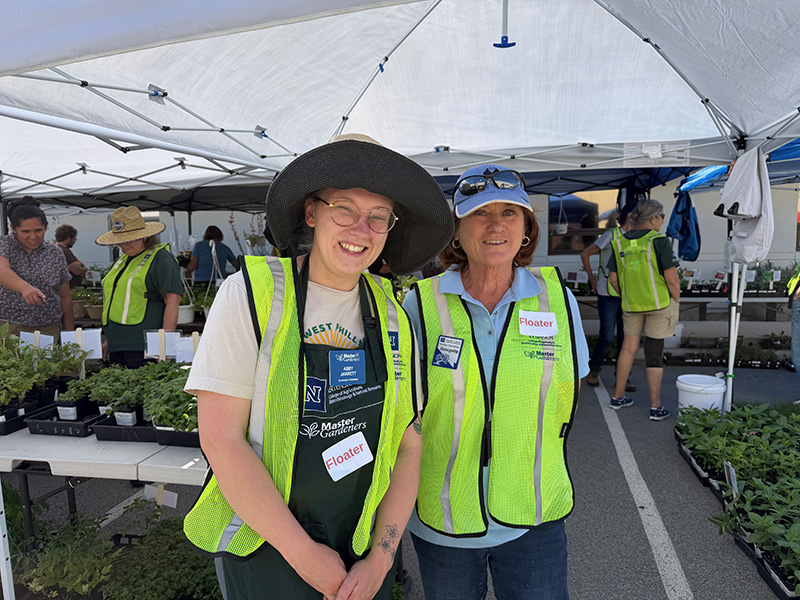
Master Gardeners Abby Jarrett and Georgette Porter are helping at the recent plant sale.
Photo credit Rachel McClure
It’s that time of year again. Finally! It’s time to plant.
Here in Northern Nevada, it is always such a guessing game. When will it be warm, when is the last freeze, is this Spring or is it just a tease?! It is also time to plant more than just our gardens.
Home Horticulture Certification program has open registration. If you have ever been interested in becoming a Master Gardener, here is the first step. Our educational process is divided into two parts. Part one, Home Horticulture Certificate, which goes over all the basics for gardening here in Nevada (but unfortunately does not answer the, when is the last freeze question). Part two (both are required to be a Master Gardener) builds on part one and is the Master Gardener series.
If you follow this newsletter, you have heard me say Master Gardeners are amazing people before. Without doubt, I will say it again. Simply because they are.
Master Gardener Volunteers do so much. They take time to learn science based horticultural information so they can answer questions. They lead educational activities in their community so people can learn. They dig in and get dirty when there is a garden in need. They volunteer their time and share their knowledge in our community week after week. They are amazing.
They make friends wherever they go. They encourage people to do more and be more. They bring meaning to so many different parts of our community. They are generous and kind. If you are lucky enough to know a Master Gardener, that is wonderful! If not, go to one of their events and say “Hi.” It will be worth your time.
If you are interested or know someone who is, please share this information with them.
- Master Gardeners of Nevada
- Home Horticulture Certificate Program Registration
Join us at one of our upcoming events:
- Spanish Springs Library Garden Talks
- Third Thursday Talks
What's Happening This Summer
Master Gardeners will continue to give short presentations on a wide range of gardening topics at various locations this summer. A mobile Master Gardener help desk will be available at some locations as well. See Locations, dates, and times below.
Garden Talks at the Library
Where: Spanish Springs Library, 7100A Pyramid Way, Sparks
Talks will be held monthly on the second Sunday from 1:30 to 3 p.m., and the mobile help desk will be available from 1 to 4 p.m..
June 14, 2026
1:30 p.m. - The Importance of Planting Native Milkweed to Support Monarch Butterflies: Monarch butterflies are among the most famous and beloved butterflies in North America. These butterflies migrate hundreds of miles from Mexico and southern California to the northern U.S. and Canada, where they lay eggs on native milkweed plants, the only plant their larvae will feed on. Providing native milkweeds in your garden can help sustain these butterflies. Come join Master Gardener Tricia Howarth to learn about native milkweed care and sources for these plants.
2 p.m. - Welcoming Pollinators Into Your Garden: Pollinators are a critical part of our planet’s ecosystems. Master Gardener Leslie Edgington will show you how to make pollinators welcome in your yard with great plants to attract them and nourish them.
2:30 p.m. - Harvesting and Curing Garlic: Did you plant garlic last fall and are now wondering when you should harvest it? Master Gardener Gary Garrett will teach you all about the right time to harvest your garlic and how to cure and store your bulbs.
July 12, 2026
1:30 p.m. - What’s Eating My Plants?: Do you have pests in your vegetable garden? Master Gardener Mary Eklund will discuss common vegetable garden pest identification and control measures.
2 p.m. - Common Tomato Problems: Are your tomato plants not producing as well as you’d like? Are you wondering if something is wrong with your tomatoes? Master Gardener Intern Connie Hetzel will discuss common tomato problems and strategies to improve your tomato production.
2:30 p.m. - Beating the Heat in the Summer Garden: Master Gardener Intern Carolyn White will share strategies and tips to help your garden thrive during the extreme heat of the season.
Aug. 9, 2026
1:30 p.m. Why and How to Garden with Native Plants: Planting native plants is always encouraged – did you ever wonder why? Join Master Gardener Intern Hannah Bishop-Moser to learn why planting natives is desirable and how to do it successfully.
2 p.m. Improving Your Lawn with Clover: Clover in your lawn is not a bad thing; it can actually improve your lawn! Learn the ins and outs of adding clover to your lawn with Master Gardener Intern Fred DeSousa.
2:30 p.m. Planting Perennials in the Fall: Did you know fall is a great time to plant perennials? Master Gardener Intern Lisa Stevens will share tips and tricks for planting perennials in the fall.
Sept. 13, 2026
1:30 p.m. Winterizing for Pollinators: Most gardeners welcome pollinators in their gardens in the spring. What can you do in the fall to help pollinators overwinter in your yard and be there when you need them? Master Gardener Kathi Linehan will share practical ways you can help pollinators this winter.
2 p.m. Get to Know Your Soil: You know it’s important to understand the soil in your yard, but where to begin? Master Gardener Colleen Kohlsaat will discuss the nuts and bolts of soil, and ways to improve your soil for growing healthy plants.
2:30 p.m. How to Propagate Dahlias: Dahlias generally don’t overwinter well in our area. But you needn’t buy them anew every year. You can lift them, divide the tubers, and have even more dahlias for next spring. Master Gardener Deb Henderson is a dahlia expert who will teach you what you need to know.
Third Thursday Evening Garden Talks
Where: Rancho San Rafael Regional Park, 1595 N. Sierra St., Reno
Join Washoe County Cooperative Extension Master Gardeners on the third Thursdays in June, July, August, and September for evening garden talks. Talks will be held in the park’s community garden, beginning at 6 p.m. and ending by 7:30 p.m. A help desk will also be available during the talks.
June 18, 2026
6 p.m. - All About Native Penstemon presented by Dawn Detton
6:30 p.m. - What’s Eating My Plants presented by Cody Phinney
7 p.m. Square Foot Gardening presented by Gretchen Bocks
Thursday, July 16, 2026
6 p.m.: Preservation Techniques, presented by Doreen Spires
6:30 p.m.: Growing Lavender, presented by Melinda Gustin
7 p.m.: The Lazy Gardeners Guide to Growing Herbs, presented by Jasmine Mehtha
Thursday, Aug. 20, 2026
6 p.m.: An Apple a Day, presented by Rene King
6:30 p.m.: Gardening with Native Plants, presented by Sara Marcus
7 p.m.: Cover Crops, presented by Kara Harris
Thursday, Sept. 17, 2026
6 p.m.: Edible Perennials, presented by Victoria Dexter
6:30 p.m.: Overwintering Crops & Winter Sowing, presented by Elsa De Jong
A Tale of Too Many Crickets
Article and photos by Carolyn White
My husband and I moved to rural Palomino Valley in April of 2024. After three years in a small condo with no growing space, I wasted no time. Our new house had a garden before it had a working water heater. I cleared a thicket of spent blackberry brambles, tilled and amended the hard-packed dirt, fussed over a small collection of purchased starts, ran drip irrigation, and obediently waited for the frosts to abate while I dreamed of eggplant parm. I planted my garden on June 1.
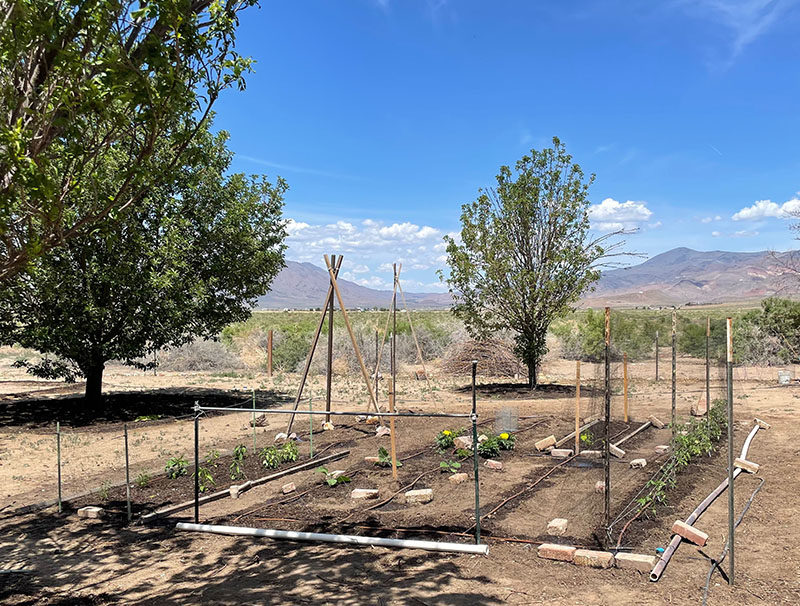
My newly planted garden, with drip irrigation.
The first Mormon crickets arrived 10 days later. What began as a handful at the top of the driveway in the morning swelled to an all-out invasion by afternoon. Mormon crickets were as thick on the ground as the weeds I dearly hoped they’d devour. They seemed to ignore those, marching instead straight into my garden.
By nightfall, my eggplants were skeletonized, and I was determined to do something. But what?
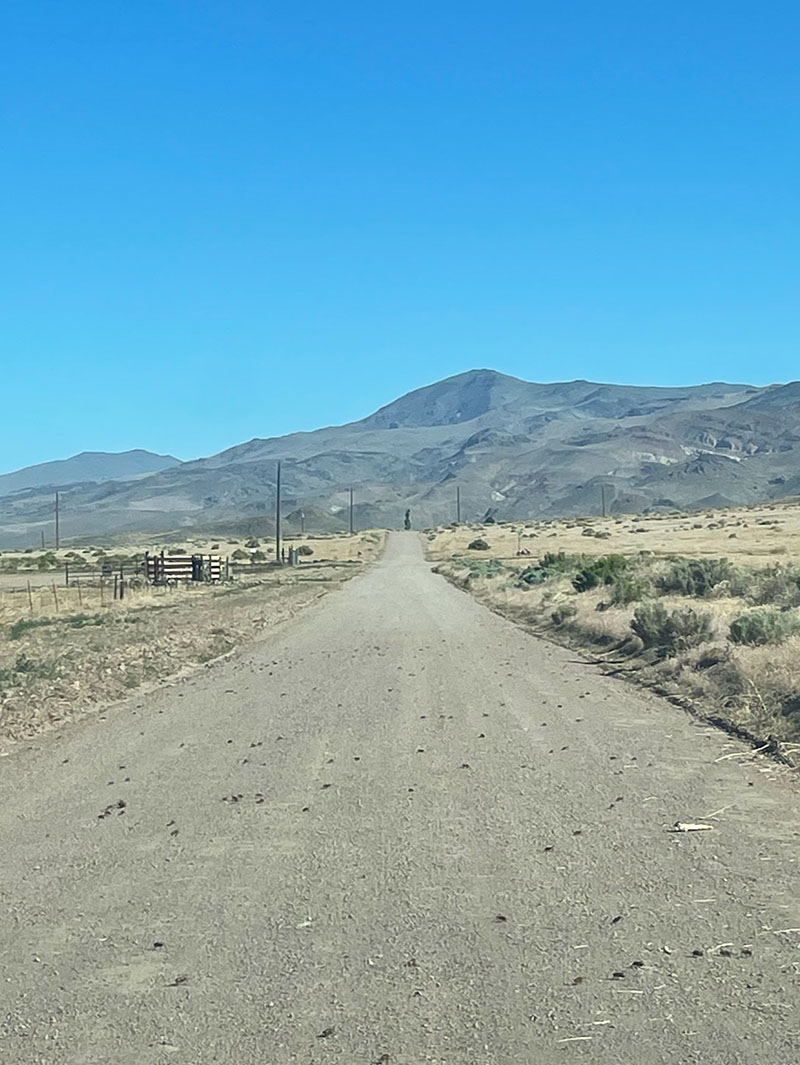
Mormon crickets arriving across the driveway.
Mormon crickets (Anubrus simplex), despite the name, are not true crickets. They are flightless shield-backed katydids, members of the Tettigoniidae family. Sixty to 90 days before they devoured my eggplant, these adult Mormon crickets emerged as nymphs from eggs deposited in the soil of the surrounding rangeland the previous summer. They hatched when the soil hit 40 degrees and then spent the next two to three months molting — seven times in all. The first four times they molted they did so without going far, but by the fifth molt they were off to the races. By the time they were adults they were covering as much as a half-mile a day in sunny conditions, feasting on forbs, grasses, and seeds as they went until, finally, they arrived at my eggplants.
But the story of how so many ended up at my eggplants occurs over years. Mormon crickets appear in great numbers on a cyclical basis, with densities building season after season. These outbreaks can persist year after year, and wreak havoc on rangeland, crops, and home gardens. The good news is that Mormon crickets are migratory, typically lingering in one place for only a few days. The bad news is they can do a lot of damage in that time, and one roving band will often be followed by another. So, what to do?
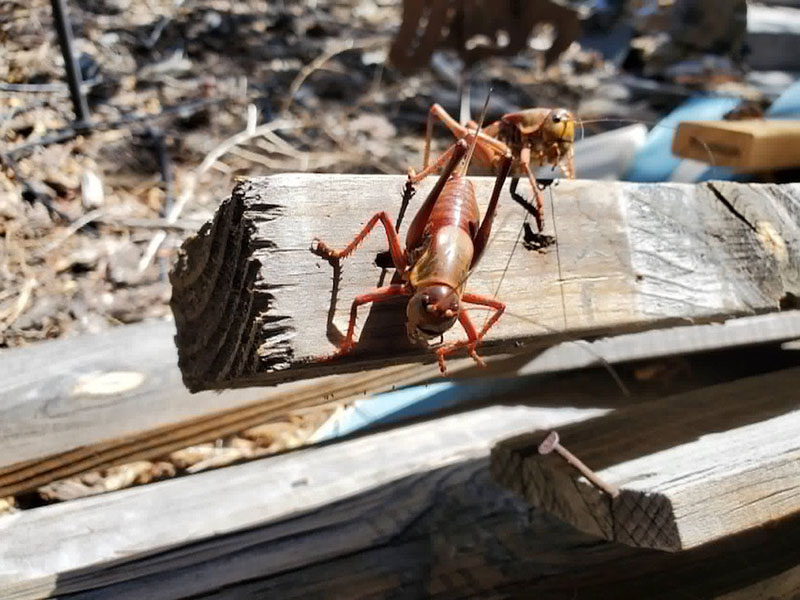
A flightless Mormon cricket.
My feverish research that night yielded several possibilities, familiar to anyone who uses the principles of Integrated Pest Management in their own garden. Cultural controls for Mormon crickets include raking up the dirt to expose eggs to cold winter temperatures so they won’t hatch. Obviously, I was a little too late to give that a shot, and even if I wasn’t, my crickets came marching from the steep, undeveloped land to my east. Chickens can be used as a biological control, but I was sadly poultry-less. As far as chemical controls, applications of malathion and diazinon are apparently effective at killing the crickets, but can affect pollinators as well. Another commonly recommended method is to apply a perimeter bait laced with carbaryl. The bait attracts the Mormon crickets; they feed on it, and die. Because they are cannibalistic, this attracts more crickets, which eat the poisoned crickets and die themselves, thereby creating a grisly wall of death. Effective (though morbid) as that sounded, I was too late to bait. The crickets were already here.
Finally, I came to physical controls. I found my ideal solution in a 1943 edition of USDA’s Farmers Bulletin entitled “Mormon Crickets and Their Control.” After a detailed description of filling moats with crude oil (not likely), the authors offered a slightly less medieval proposition: a slick barrier at least 10 inches high, staked on its non-cricket-infested side. They recommended sheets of galvanized iron, which (unsurprisingly) I didn’t have on hand. What I did have was three-mil plastic sheeting, zip ties, and rusty pipes. I pounded the pipes into the ground, threaded zip ties through the sheet plastic and around the pipes, buried the edge under several inches of soil, and added loose bricks for good measure. Then I hunted down the dozen or so Mormon crickets I’d trapped inside. By 10 o’clock the next morning, my garden was ugly but fortified.
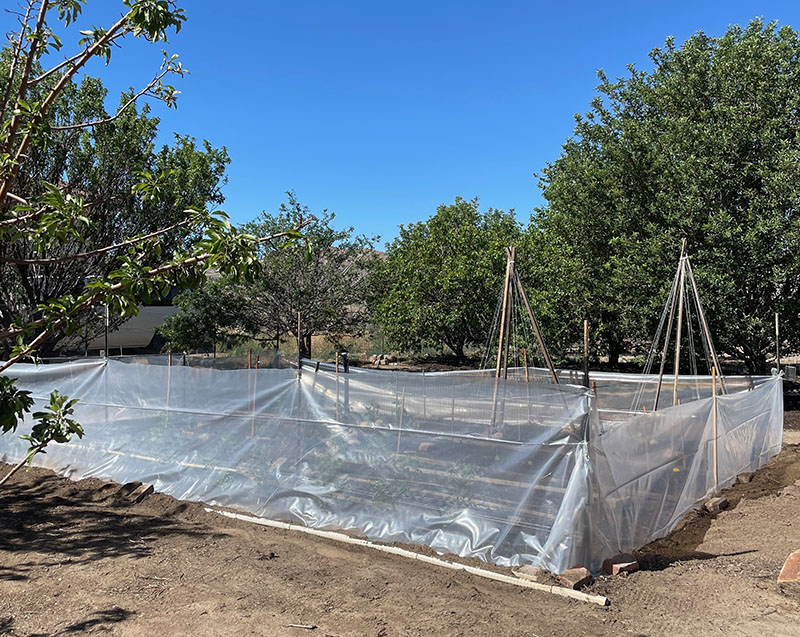
A physical barrier of plastic sheeting, zip ties, and rusty pipe.
And the crickets? Defeated. Marching in circles around my plastic walls, chirping in frustration.
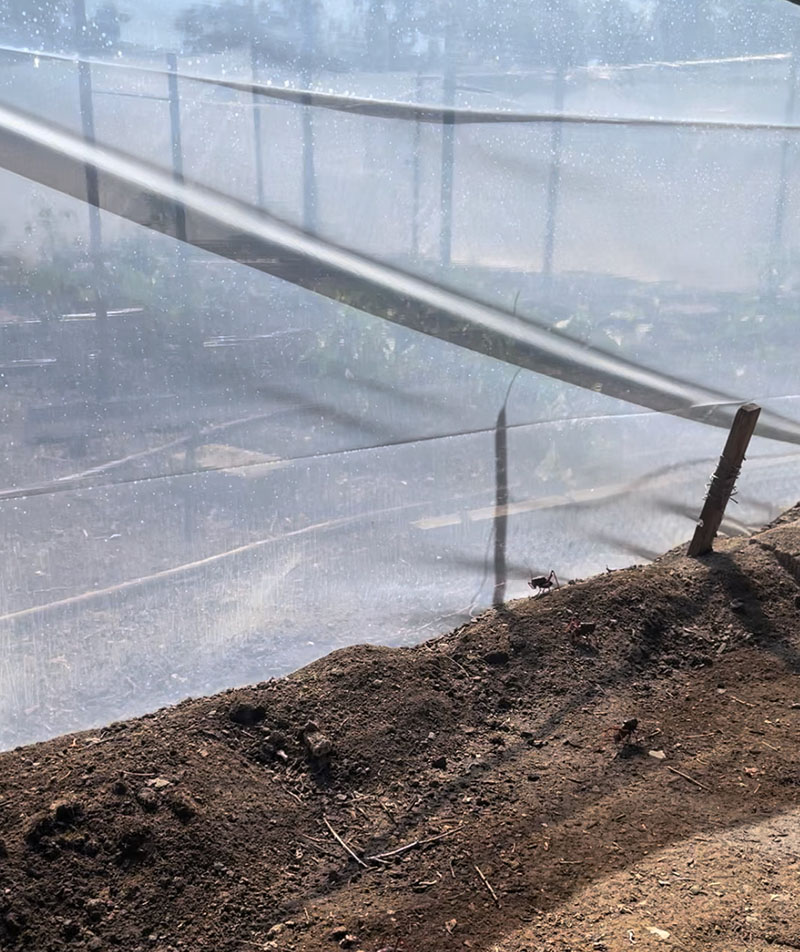
Defeated Mormon crickets, marching in circles around the plastic walls.
A week later, the crickets abated, my garden was rapidly recovering, and I was back to dreaming of eggplant parm.
References
- Cowan, Franklin T., Claude Carl Wakeland, and Horace Jennings Shipman. “Mormon Crickets and Their Control.” No. 1928. US Government Printing Office, 1943.
- Holmgren, Lyle. “Home and Garden Guide to Mormon Crickets and Grasshoppers.” 2003.
- MacVean, Charles M. Ecology and Management of Mormon Cricket, Anabrus simplex Haldeman. “Integrated Pest Management On Rangeland.” CRC Press, 2019. 116-136.
- Pfadt, R.E. “Mormon Cricket Anabrus simplex Haldeman.” Wyoming Agricultural Experiment Station Bulletin 912, 1994.
A Long Season of Bloom in a Shade Garden
Article and photos by Anna Anderson
The aim of many a perennial garden is to have something always in bloom, and the possibilities in a sunny border are endless, from the first snowdrops of spring to the last hardy aster in the fall. But what if the garden is in the shade?
Many perennial plants thrive with as little as one or two hours of sun a day, preferably in the morning. And it’s entirely possible to have a long period of color from such a garden, whether from blooms or foliage or both. It may not span three seasons, but it’s a continuous unfolding of beauty.
These are the plants that came back in my shade garden and the order they appeared.
Lenten rose (Helleborus x hybridus), which is not a rose but a member of the buttercup family, is the earliest to bloom. As its common name suggests, its flowers of white, pink, purple, and green appear around the Christian season of Lent, in late winter.
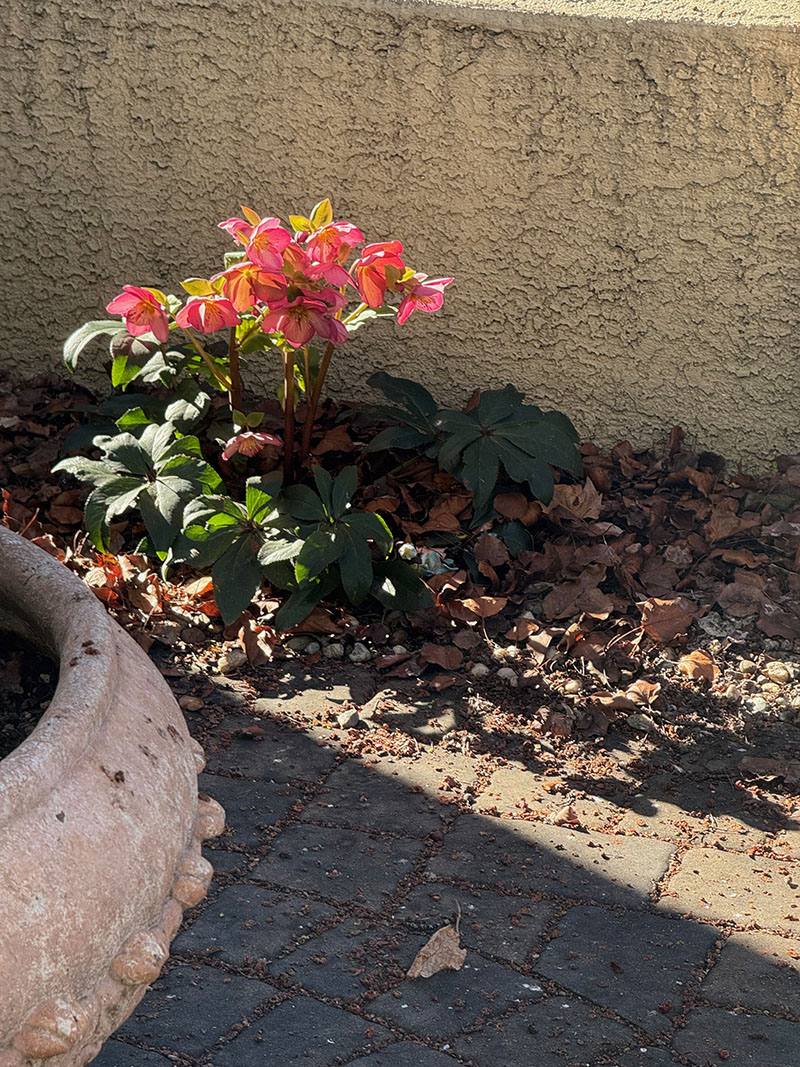
Lenten rose,
Helleborus x hybridus, cannot tolerate
high temperatures and is toxic to humans and pets.
Lungwort (Pulmonarea spp.), one of my favorites with its spotted leaves and pink, purple, white, and blue flowers, also blooms in late winter, and its foliage lights up a shady spot when the flowers have faded..
Next up are rhododendrons (Rhododendron spp.), a flowering shrub that is also early to the flower show, from late winter into early spring. Its clusters of bell-shaped blooms come in many colors, including white, pink, red, purple, and yellow. The Rhododendron genus includes azaleas, which also comes in a broad range of colors, sizes, and sun tolerance. I have a so-called Sun Azalea in orange. Neither rhododendrons nor azaleas are common in northern Nevada gardens, not just because of our abundant sun but also because of our alkaline and sometimes poorly drained soil. In the right microclimate, though, they can be grown successfully here.
Bleeding heart (Lamprocapnos spectabilis) is another favorite of mine. These plants, grown from tubers, disappear entirely over winter and are slow to emerge in the spring. But once above ground, they are quick to show their beautiful heart-shaped flowers, held along arching stems. These traditionally have pink, red, or purple outer petals with white in the middle.
Another shade-loving spring bloomer is coral bells (Heuchera spp.). I have one with green leaves that offers long-lasting coral flowers, and one with darker leaves that produces delicate white flowers. Cross-species Heuchera hybrids are increasingly available, with foliage in a wide range of red, maroon, light yellow-green and pale orange hues, which can add colorful accents to a shade garden after their flowering season.
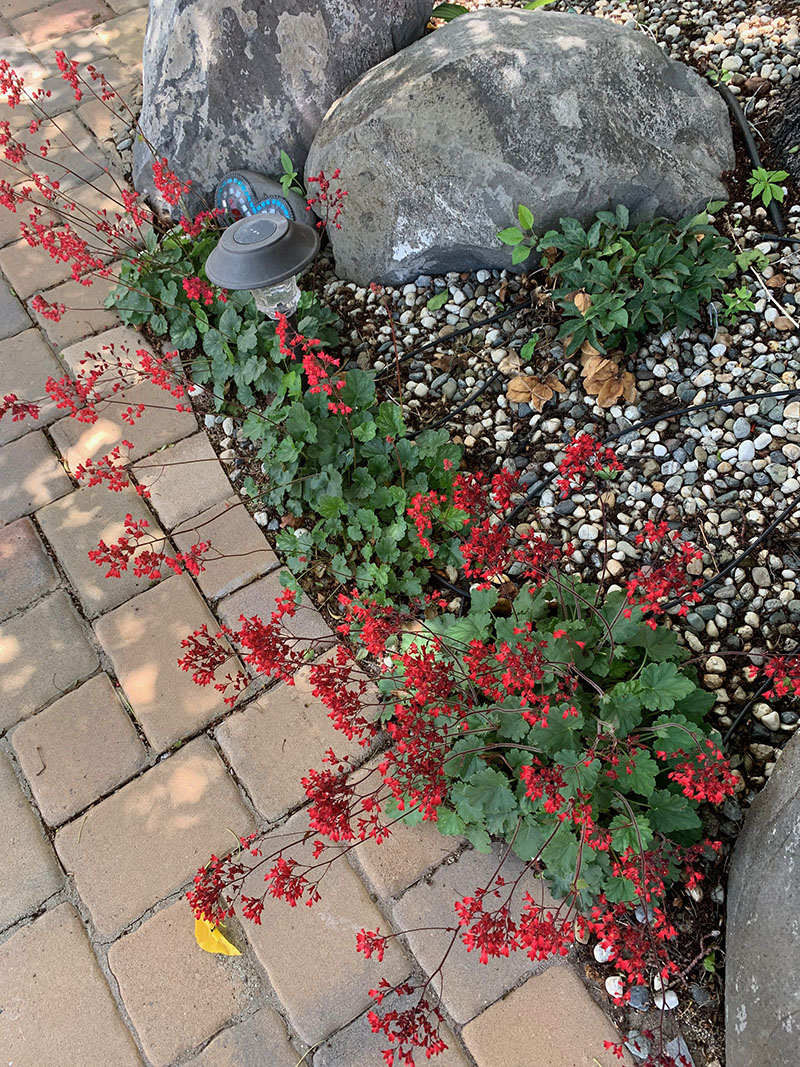
Coral bells, Heuchera spp., are rich in nectar, the flowers
attract hummingbirds and butterflies. They also make nice cut flowers.
Columbines (Aquilegia spp.) are also spring-flowering, and available in many colors as well as bi-colored versions. While gardeners in cooler climates can grow these in full sun, in our climate they will need at least partial shade as they do not tolerate excessive heat.
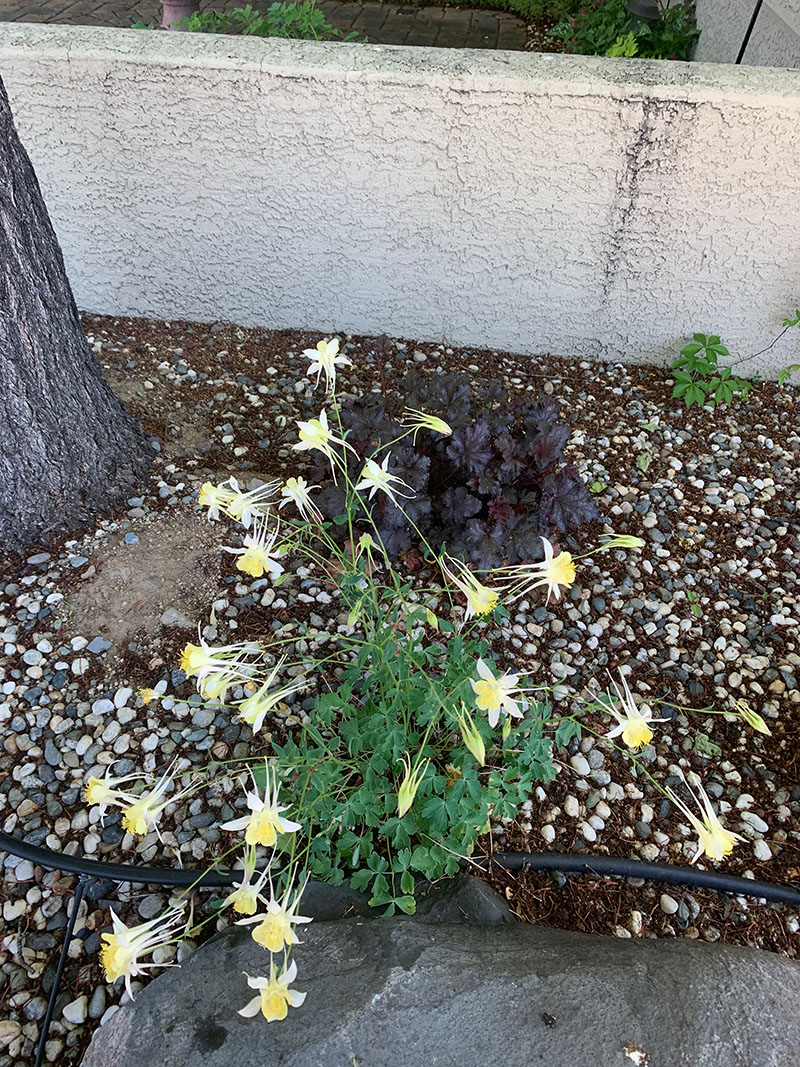
Columbines, Aquilegia spp., the blooms
are said to resemble a jester’s hat. They are toxic to humans.
And last, but surely not least, hostas (Hosta spp.) are a long-time favorite of shade gardeners, available in sizes from miniature to giant, and in a huge variety of leaf shape texture, and color, including many striking bi-colors. In my garden I have a little one, ‘Blue Mouse Ears’, which will top out at 12” and a giant, ‘Guacamole’, which can get to 30” or more. These are not spring bloomers. Their flowers, usually in shades of lavender, come in the summer to early fall. Some gardeners remove the blossoms, thinking they detract from the foliage. If you leave them, the hummingbirds will thank you.
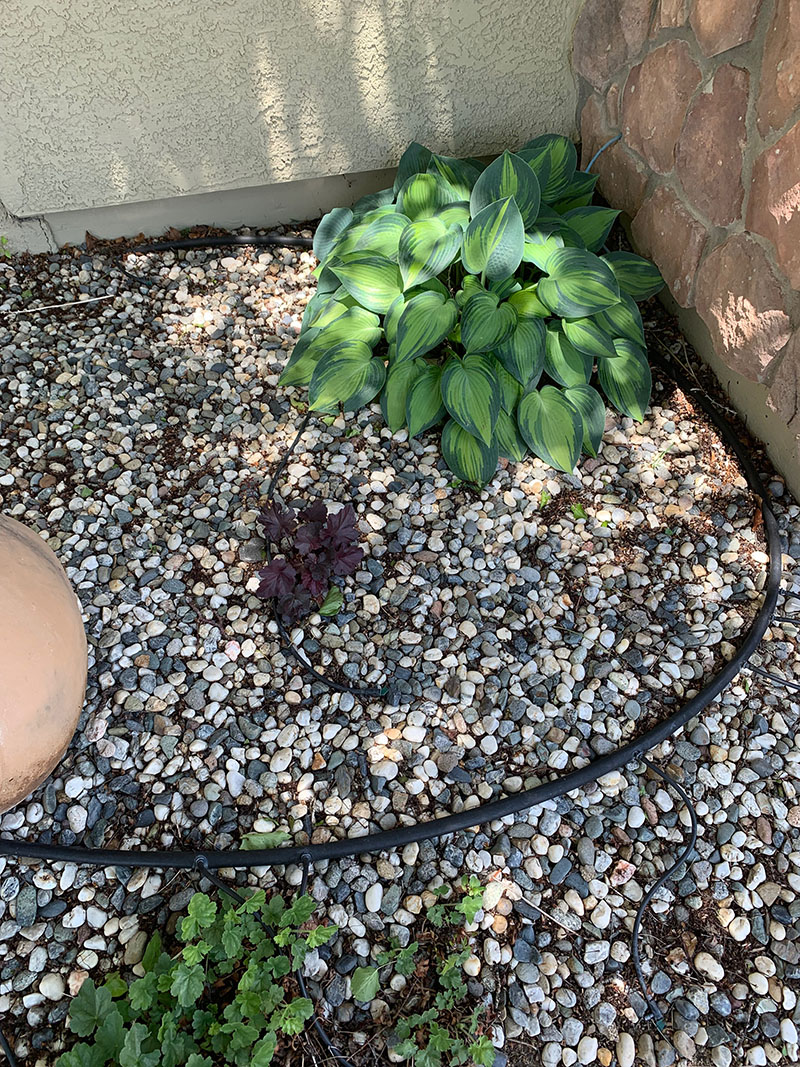
Hosta, Hosta spp., do not plant in clay soil because it holds too much
moisture. Deeper infrequent watering is better than frequent shallow applications.
This year, I'll be adding lily of the valley (Convallaria majalis), a ground cover grown from rhizomes. I’ll look forward to its tiny, fragrant, bell-shaped flowers in the spring.
More information:
Lenten rose likes to be under trees in fertile, well-drained, moist soil. These plants are hardy in zones 6-8 and can grow to 12-18 inches tall.
My first lungwort was called ‘Shrimps on a Barbie.’ The Farmer’s Almanac online (states, “It asks little and gives plenty.” It grows in zones 3-8, is deer- and rabbit- resistant and attracts butterflies.
Rhododendron is a woody shrub, grown in zones 4-8. It likes well-drained, acidic soil and is best planted on the north or east side of your home. It needs constant moisture and mulching to protect its shallow roots. Prune after the spring bloom and feed with an acid-based fertilizer.
Azaleas grow in zones 6-9. Like other rhododendrons, they like pH levels of 4.5-6, and they need constant moisture. Prune after the spring blooming and feed with an acid-based fertilizer. I don’t have a picture of my plant in full bloom because I have a bobcat who likes to go through my yard and he injured my plant.
Bleeding heart grows in zones 3-9 and appreciates mulch. It will go dormant by summer; and its foliage is slow to emerge in the spring. Be patient!
Coral bells prefer morning sun to afternoon shade. They like moist, well-drained soil, and grow in zones 3-7. An interesting note is that the darker-leaved ones handle more sun than varieties with lighter leaf colors.
Columbines need to be mulched and thrive in zones 3-9. They are prolific and self-seeding, which allows them to continue to grow in your garden. A bonus: Hummingbirds love them.
Hostas are hardy, low-maintenance, and grow in zones 3-9. The blue ones need more shade than other colors, and the golden ones need fewer hours of morning sun. Fertilize in the spring. Deer, snails, and slugs can be a problem.
Gardening as a Tool for Mental Well-Being
Articles and Photos by Frances Munoz
In recent years, there has been growing recognition of the connection between gardening and mental health. While many of us were first drawn to gardening through a love of plants, design, or food production, we often discover that the benefits extend far beyond the garden bed.
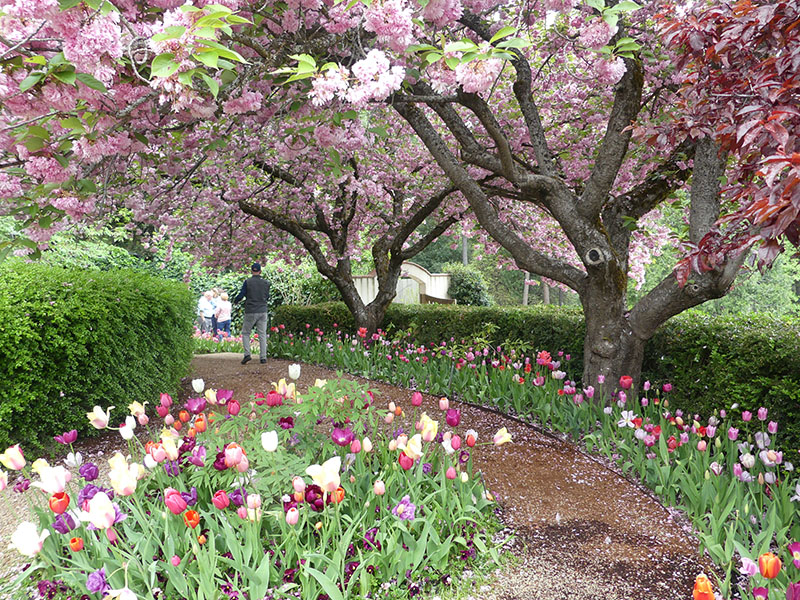
A colorful winding path of tulips and flowering trees at
Crystal Hermitage Garden invites one to slow down and be present in the moment.
Gardening offers a unique combination of physical activity, cognitive engagement, and emotional restoration, making it a powerful, accessible tool for supporting mental well-being.
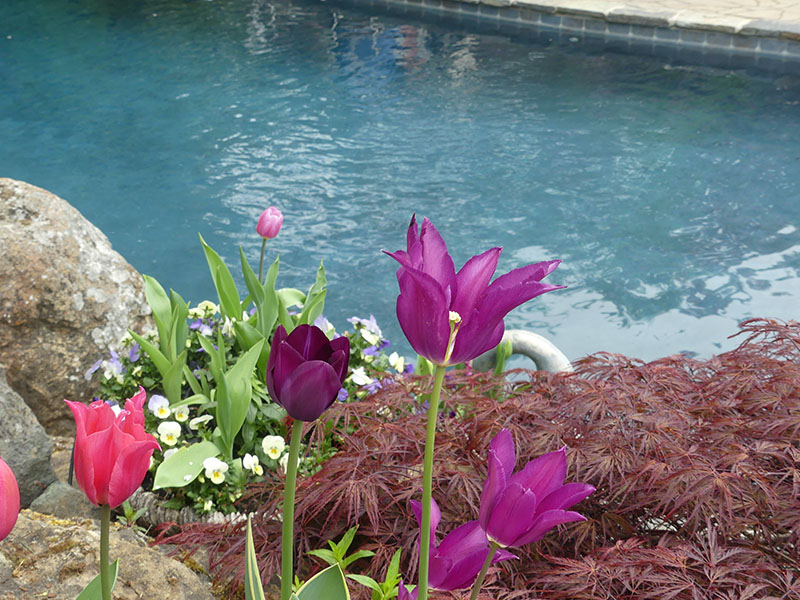
Tulips and still water offer a moment of calm and balance.
Photo taken at Crystal Hermitage Garden.
The Science Behind the Calm
Working with soil and plants engages the senses in a way few other activities do. The tactile experience of soil, the scent of plant material, and the visual rhythm of garden spaces all contribute to a calming effect on the nervous system.
Research suggests that exposure to green spaces can reduce stress hormones and improve overall mood. Repetitive gardening tasks can also promote mindfulness and reduce mental fatigue.
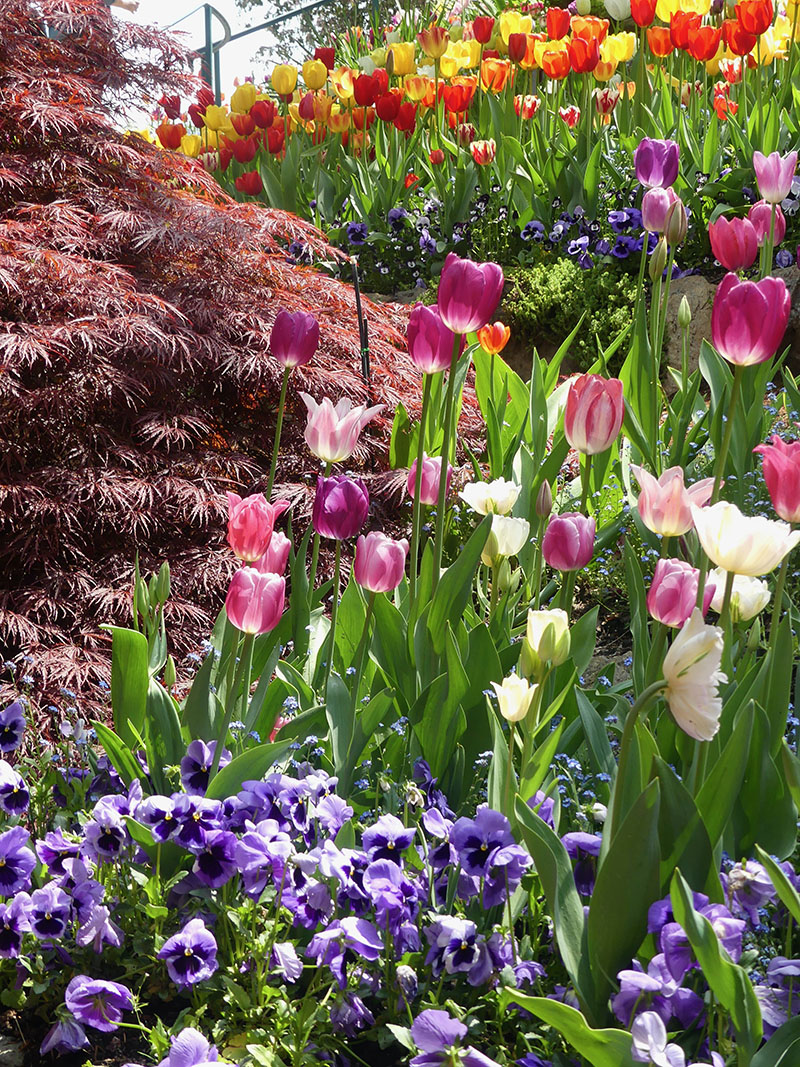
A weeping Japanese maple and vibrant multi-colored tulips reward the senses with both beauty and stillness.
Photo taken at Crystal Hermitage Garden.
Additionally, soil microbes such as Mycobacterium vaccae have been studied for their potential role in supporting serotonin production and emotional regulation.
Routine, Responsibility, and Resilience
Gardens require consistency. Watering schedules, seasonal pruning, and soil preparation create structure and routine elements that are especially beneficial during times of stress or uncertainty.
Gardening also reinforces resilience. Not every plant thrives, weather conditions shift, and success often follows trial and error. This process mirrors life in meaningful ways, encouraging patience, adaptability, and acceptance.
Gardening and Emotional Health
Gardening can be particularly supportive for those experiencing stress, anxiety, or depression.
Benefits include increased exposure to natural light, gentle physical movement, and a sense of accomplishment and purpose.
Even small successes -- new growth, a first bloom, or harvested vegetables -- can provide meaningful moments of encouragement.
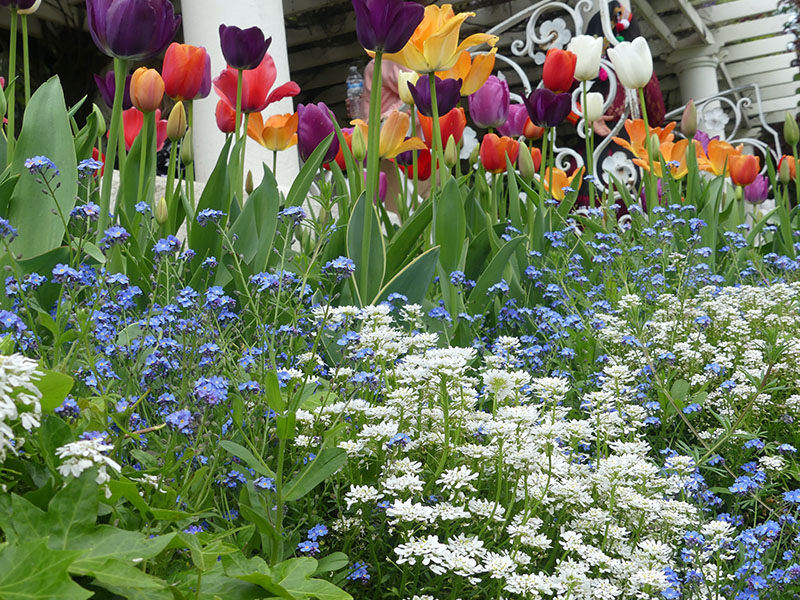
Blooming tulips, iberis, and other spring flowers by a patio remind us that
even small spaces can offer moments of restoration.
Photo taken at Crystal Hermitage Garden.
The Role of Master Gardeners
As Master Gardeners, we are uniquely positioned to extend these benefits into our communities.
Through education, outreach, and demonstration gardens, we help others experience not just the how to of gardening, but the why it matters. Programs that encourage participation, whether through container gardening, native planting, or pollinator support, can improve both horticultural success and personal well-being.
Nevada Gardening & Mental Wellness
In Northern Nevada’s high desert climate, gardening comes with unique challenges. Temperature swings, dry conditions, and soil limitations. Yet these same challenges can deepen the mental health benefits of gardening.
Working with native and drought-tolerant plants encourages observation, patience, and adaptability. Even small successes in this environment can feel especially rewarding, reinforcing resilience and connection to place.
Cultivating More Than Plants
Gardening is often described as growing plants, but in practice we are cultivating much more: connection to nature, connection to each other, and connection to ourselves.
In a time when many people feel increasingly disconnected, gardens remain one of the most accessible and effective ways to restore that balance.
Closing Reflection
In my own experience, some of the most restorative moments don’t come from big accomplishments, but from simple time in the garden. Hands in the soil, attention focused, and the outside world momentarily quiet.
As gardeners, we understand that growth takes time, attention, and care. The same is true for our well-being.
Sometimes, the most important thing we can grow… is a moment of peace.
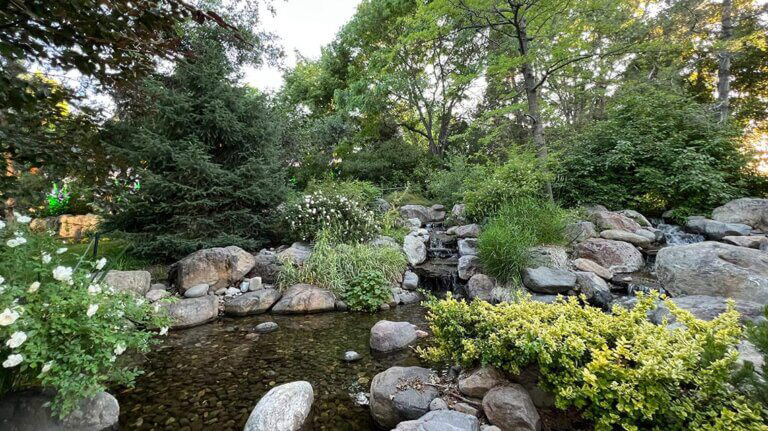
The gentle movement of water at Honey’s Garden waterfall, located at Wilbur D. May Arboretum
& Botanical Garden, creates a sensory pause where sound, motion, and nature come together in quiet harmony.
References
- American Horticultural Therapy Association. (n.d.). Horticultural therapy. https://www.ahta.org
- Centers for Disease Control and Prevention. (2022). Physical activity and mental health. https://www.cdc.gov/physicalactivity/basics/pa-health/index.htm
- Lowry, C. A., Hollis, J. H., de Vries, A., Pan, B., Brunet, L. R., Hunt, J. R. F., & Lightman, S. L. (2007). Identification of an immune-responsive mesolimbocortical serotonergic system: Potential role in regulating emotional behavior. Neuroscience, 146(2), 756–772.
- Mayo Clinic. (2023). Stress relief from exercise: Get moving to manage stress. https://www.mayoclinic.org
- Royal Horticultural Society. (2016). Gardening is beneficial for health: A review of the evidence. https://www.rhs.org.uk
- Ulrich, R. S. (1984). View through a window may influence recovery from surgery. Science, 224(4647), 420–421.
- van den Bosch, M., & Bird, W. (2018). Oxford textbook of nature and public health: The role of nature in improving the health of a population. Oxford University Press.
Growing Cilantro in a Warm Climate
Article and Photos by Joanne McClain
Cilantro (Coriandrum sativum), also known as coriander, is a cool-season herb that does best in a sunny location with well-drained soil. Cilantro and coriander are different parts of the same plant. The leafy plant is called cilantro; coriander refers to the seeds that are used as a spice. The plant can withstand a light frost and even a temperature down to 28 degrees if it is not prolonged.
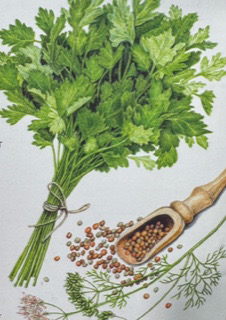
Seed packet showing the
cilantro herb and coriander seeds.
Cilantro can be a difficult plant to grow in warm climates due to its tendency to bolt in hot weather (when cilantro bolts and produces flowers, the leaves turn bitter). The fresh taste of home-grown cilantro is worth the effort.
Here are some tips for getting the maximum production out of your cilantro in hot weather:
- Give your cilantro about six hours of sunlight in the beginning of the day with afternoon shade.
- Mulch your soil to keep it cool.
- Use shade cloth. This can really make a difference.
- Water deeply to keep roots cool and moist, but avoid soggy soils.
- Plant in a container that can be moved to a cooler spot during heat waves.
- Cilantro develops a long taproot. Planting in a pot that is at least 8 inches deep can delay bolting.
- Grow cilantro from seed. Nursery starts are already several weeks old and transplanting stress can encourage bolting. Cilantro is easily grown from seed.
- Sow new seed about every two weeks for a continuous supply.
- Check daily for any flower stalks and remove them immediately.
- Harvest frequently. Cilantro is fast-growing.
- Harvest sprigs when they are about 6 inches long. You can cut the outer leaves to about 1 to 2 inches above the soil, or snip the main stem down to its last set of leaves. Some growers recommend harvesting no more than a third of the plant at a time.
One of the best things you can do is plant cultivars described as slow-bolting or long-standing. Most seed companies offer such varieties; I found several available by seed in local stores. One simply was labeled “Slow Bolting Cilantro” with no variety mentioned. Only a few of the nursery-grown cilantro plants that I saw were labeled by variety.
If you don’t find what you want in a garden store, check online. Here are some of the varieties available as seed:
Santo: Long-standing cilantro.
Cruiser: Specifically grown to be bolt-resistant. Large aromatic leaves.
Calypso: Slowest to bolt. Claimed to bolt three weeks later than Santo.
Moroccan: This is an early bolter, but is especially good for coriander lovers because of its extra-large seeds. The leaves still have the classic cilantro flavor.
Dwarf Lemon: A compact plant with hints of lemon. Does best in cooler weather, and is not bolt-resistant.
Whether you cut cilantro from your garden or buy it at the grocery store, you can extend its freshness by putting it in a container with about an inch of water. Cover it loosely with a plastic bag and store it in your refrigerator. Change the water every couple of days. This method can keep your cilantro fresh for at least two weeks.
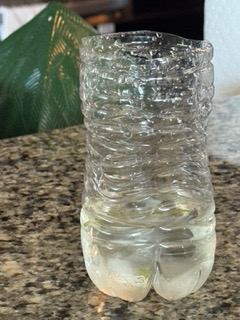
A cut plastic water bottle works
well for storing cut cilantro.
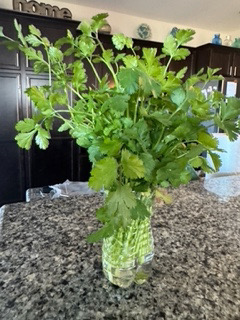
You can leave the cut cilantro on your counter,
but it will stay fresh much longer in the refrigerator.
Cilantro can be frozen, but should only then be used in cooked recipes.
Remember the Water for the Fauna
Article and photos by Becky Colwell
If you’re thirsty, they’re thirsty. Most of us know the value of planting flowering plants that attract pollinators and beneficial, but we should also be providing shelter from weather, nesting sites, and, especially in the summer, water.
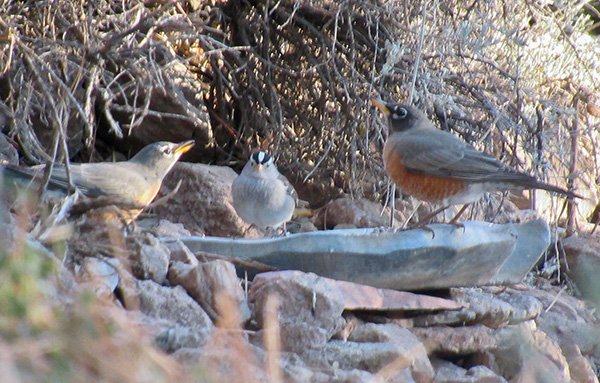
Robins and a sparrow enjoying a refreshing drink on a hot day.
The optimal temperature for bees to fly is 50 degrees F. to 90 degrees F. As we know in Northern Nevada, the summer tends to have more days above the 90-degree mark. Watering sites help our pollinators withstand those temperatures.
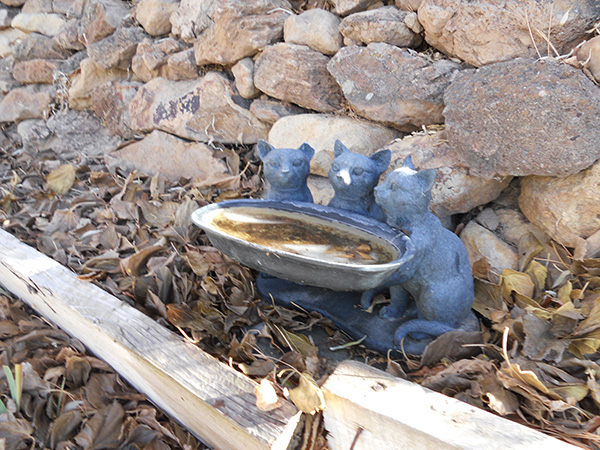
A watering station overseen by cats.
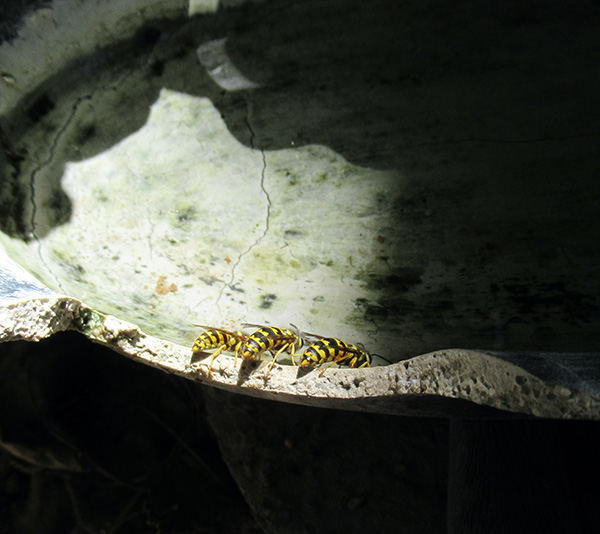
Three meat bees (really wasps) drinking from my cat watering station.
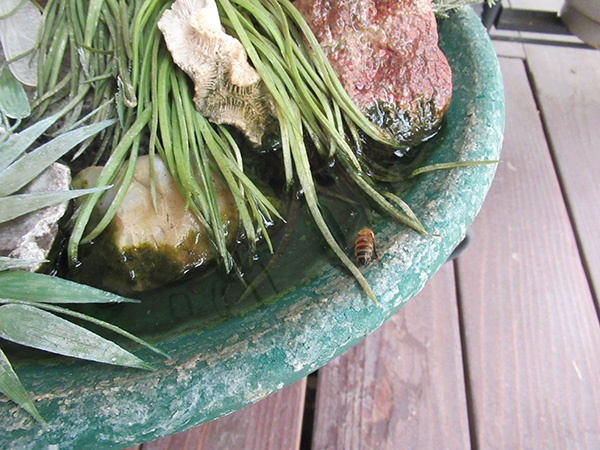
A honey bee drinking from a small fountain on my deck.
You can get creative with your water containers. A large half of a clam shell works, as does a grinding stone, a pot saucer, and a water lily made out of cement. Put the container in a fairly shady part of your garden on the ground, where it will be accessible to more fauna. For birds, it is nice to also locate your container under a tree or shrub. After bathing, birds like to fly to a branch and preen.
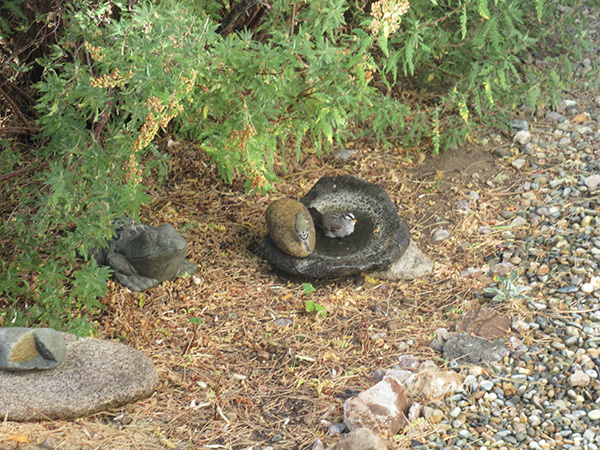
A finch and mountain chickadee enjoying the cool water
in a grinding stone placed under my fern bush.
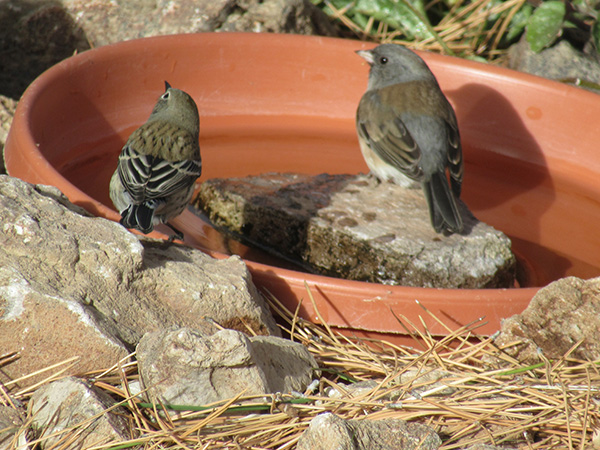
Dark-eyed juncos drinking from a pot saucer equipped
with a landing rock. This is placed under my Austrian pine tree.
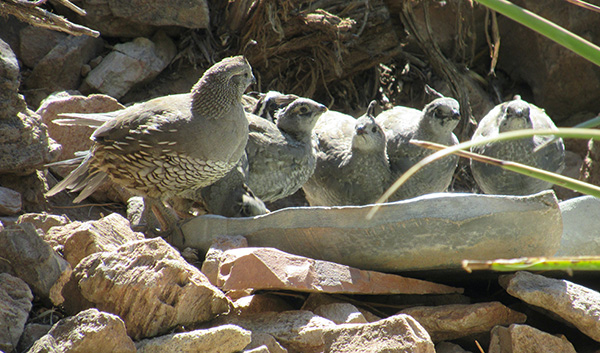
Juvenile quail getting a morning drink from my cement lily pad.
Here are some tips for water sources in your garden.
- Birdbaths should be shallow, one to three inches deep, with sloping sides or a landing rock.
- Insects need a shallow container with sloping sides or small rocks to land on.
- Butterflies get their water and minerals through “puddling.” Fill a very shallow dish with soil or sand and add water to make a mud concoction.
- Keep the containers clean and replace the water every day to keep mosquito larva out.
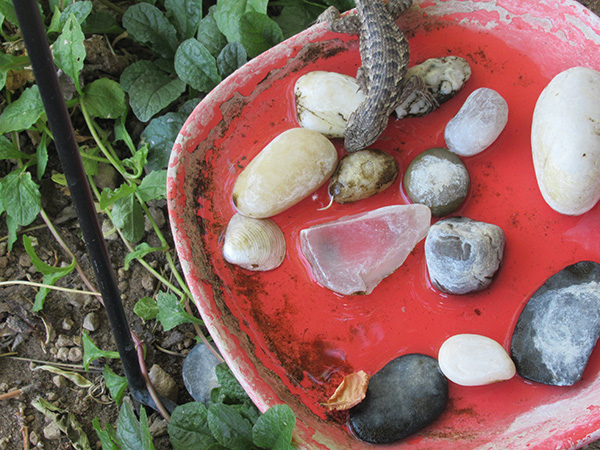
Even lizards need a cool drink during the hot months of summer.
This lizard is sneaking a drink from one of my insect watering stations.
The Trials of Tomato Growing
Photos & article by Beth Heggeness
Once again, the unpredictable weather in Reno kept gardeners guessing on when to plant the tomatoes. But presumably the passage of Memorial Day has signaled stability, and most of 2026’s tomato crop is in the ground or soon headed there.
From now until August, the focus is on production practices, pests, and potential problems (okay, I got carried away with the alliteration there). As the old-timers say, the best fertilizer is the footsteps of the farmer, so I hope you can enjoy “walking your garden” for at least a few minutes each day, observing what’s happening there so you can take action as needed. Notice pollinator activity, unidentified flying objects (insects?), a “weed” (especially one you didn’t notice until ACK!) Or, maybe it’s a whiff of something fragrant, a glimpse of a thriving plant that seemed lackluster just days ago, or the first appearance of fruit on your tomato plant.
Watch the Weather
Pay attention to the weather news, whether on TV, radio, or online, but keep it local. It matters not what’s happening in Florida, Kansas, Las Vegas, or Sacramento. What’s in store for your garden is all that’s important. Temperatures, high as well as low, matter. High winds matter. Rain matters, and that’s a tough thing to monitor closely in the Washoe Valley, considering that your neighbor’s garden may get a nice little drink while yours stays thirsty. Get a rain gauge and check it. We have a lot of microclimates in our area, including the ones in your own garden space.
Watering the Tomatoes
Newly transplanted tomatoes need a little more frequent watering, but as their roots develop and plants grow taller, aim for 1 to 2 inches a week, taking any natural rain into account. One inch of water will wet a sandy soil to a depth of 10 inches, clay soil 6 inches deep. Check moisture depth with a trowel just outside of the plant root zone and adjust your watering schedule accordingly.
Tomatoes are in a small family of plants that benefit from deep planting and deep watering. Tomatoes that are encouraged to grow deeper roots will ultimately be more successful. It’s fine to cut back the irrigation a bit on mature plants, but consistently moist soil is important to avoid problems like blossom-end rot. An inch or two of mulch can help maintain soil moisture in the root zone even if the top soil layer is allowed to dry out between watering.
For best production, space your plants about 24 inches apart on all sides. Be sure to provide support for indeterminate vines by staking, caging, or trellising. Use a flexible tie to support vines as they grow.
To Feed or Not to Feed
“Native” soil here is typically nutrient-poor and alkaline, so the general rule is to enrich it every year with organic material, like compost, leaf mold, and well-aged manure. And yes, it’s good to give your new transplants a head start by adding fertilizer. A balanced fertilizer, like 10-10-10, which has equal amounts of nitrogen, potassium, and phosphorus, is fine. A touch more nitrogen is also fine (tomatoes tend to be pretty leafy), but don’t overdo it or you risk growing bountiful foliage at the expense of fruit.
Experts offer differing advice on side-dressing tomatoes (adding additional nutrients as the season progresses). Some recommend a high-nitrogen supplement after the tomatoes have been in the ground for a month or two. But proceed with caution, and be sure you know what sort of climate that expert is growing tomatoes in. Northern Nevada’s growing season is short, especially for the big, juicy slicing tomato varieties that many gardeners crave. At some point, the plant has to stop growing and get busy ripening tomatoes.
Pests and Problems
Aphids: Early in the season, your tomatoes may be afflicted with aphids, small soft-bodied insects that suck juices from tender, early growth. They cluster on emerging stems and leaves. Carefully inspect emerging growth, including the undersides of leaves. You can gently brush them off by hand, or knock them off plants with a forceful spray of water. A healthy supply of lacewings and lady beetles is your best defense, though, so avoid chemical interventions if you can, to spare the beneficials.
Earwigs: These are a potential pest for newly transplanted plants of many kinds, including tomatoes. If you find a plant severed at the base of a stem, dig gently around and look for a C-shaped grub. Protect new seedlings by placing a “collar” around the plant stem, an inch or two deep and extending above the soil. You can use tuna cans or aluminum beverage cans with tops and bottoms removed, or cardboard tubes cut from paper towel rolls.
In the past, I’ve had problems with earwigs chewing on young seedlings (they hide out in moist places under pots on the patio or in damp mulch and come out at night to munch.) Once plants are established, they are not much of a problem, and earwigs do useful work in the garden by cleaning up dead and dying plants. But as pests, they are easy to trap with a shallow container, like a tuna can, filled with an inch of vegetable oil and a dash of soy sauce. In the morning, empty the captured earwigs into a bucket of soapy water to do them in. 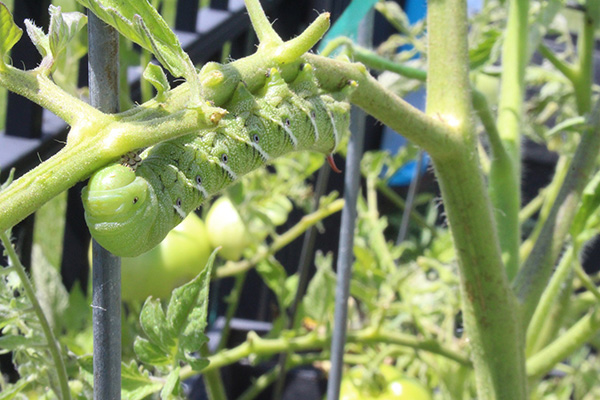
Tomato hornworms can blend in with foliage and reach up to five inches in length. Monitor your tomato plants daily and check under the leaves for eggs. Photo credit: Sheri Elena Quinn.
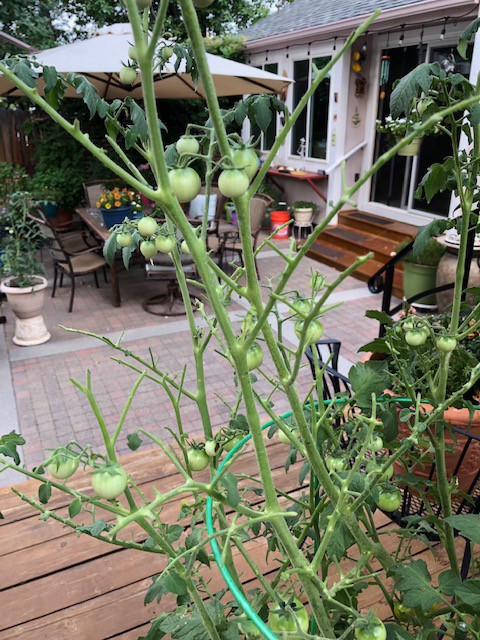
Hornworms can defoliate a plant in a day. Photo credit: Sheri Elena Quinn.
Hornworms: The tomato hornworm and its cousin, the tobacco hornworm, are frequent pests in Northern Nevada gardens. These large caterpillars are the larvae of nocturnal moths, commonly called sphinx or hawk moths. While the moths are handsome and often much admired by those up late enough to see them, their offspring are homely and voracious. A few hornworms can defoliate a tomato plant in a few days. Their size makes them relatively easy to spot on your daily walk, though, and they are easy to pick off and dispose of. Or feed to your chickens if you have some. A side note: The hummingbird moth, or white-lined sphinx moth, that delights many gardeners as it flits about sipping nectar from spring blooms, is not the mother of the tomato hornworm. It flies in the daytime, not at night, and its larvae prefer plants other than tomatoes. Its caterpillars are usually yellowish, not green, and it has horizontal dark stripes, not the white stripes of tomato hornworms.
Common Non-Pest Problems
Tomatoes are thin-skinned and vulnerable to some disorders caused by environmental stress factors rather than insect, fungus, virus or other biological vectors.
Blossom Drop: Perhaps the most disheartening physiological malady is blossom drop, which prevents the tomato from setting fruit at all. A seemingly robust tomato plant may be loaded with yellow blossoms, but they dry up and fall from the plant without setting fruit. This is often caused by a confluence of events, including high temperature, humidity, sunlight intensity, and scarcity of pollinators. Daytime temperatures of 90 degrees will slow fruit set. Temperatures over 94 degrees will stop it altogether, as will nighttime temperatures over 75 degrees. High temperatures may also discourage pollinators. Tomatoes have so-called “perfect” flowers, with male and female parts on the same blossom, which means they can pollinate themselves with an assist from the wind. But on a hot summer day with not even a refreshing breeze, you may need to give your tomato plant a good shaking to stir things up.
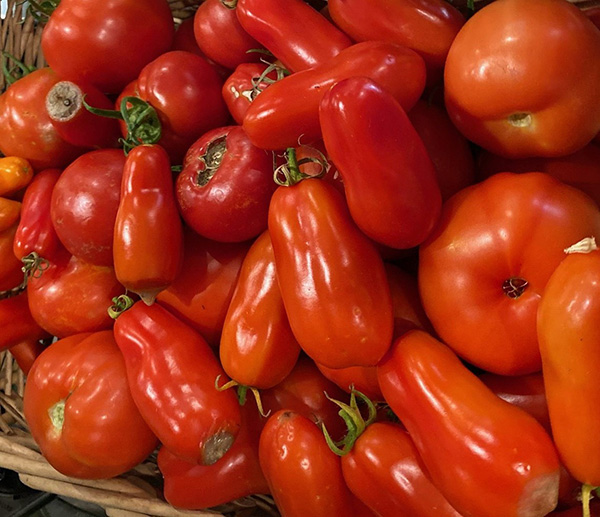
Blossom end rot has left the tips of some of these plum tomatoes discolored or scabby. The rest of the ripe tomato is still edible, however. Photo credit: Janelle Michel.
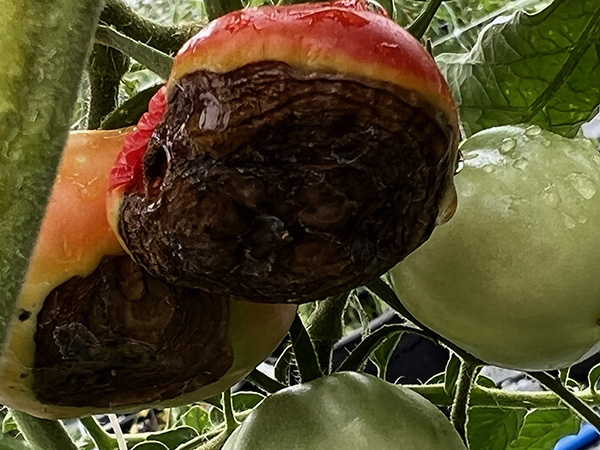
A severe case of tomato blossom end rot.
Photo credit: Rachel McClure.
Blossom End Rot: Your ripening fruit suddenly develops dry brown or black skin at the blossom end, even though the flesh nearest the stem seems normal. This is caused by a calcium deficiency, but it won’t help your tomatoes to add crushed egg shells or calcium supplements to your soil, which in all likelihood has plenty of calcium already. The problem is that the tomato isn’t able to access that calcium in your soil because of inconsistent moisture levels. Regular, sufficient watering is the most effective method to prevent this disease. You want consistent, even moisture, not swings between too dry and too wet. Mulch can help. Check moisture levels on every walk in the garden, as diligently as you monitor temperatures, drought conditions, and wind.
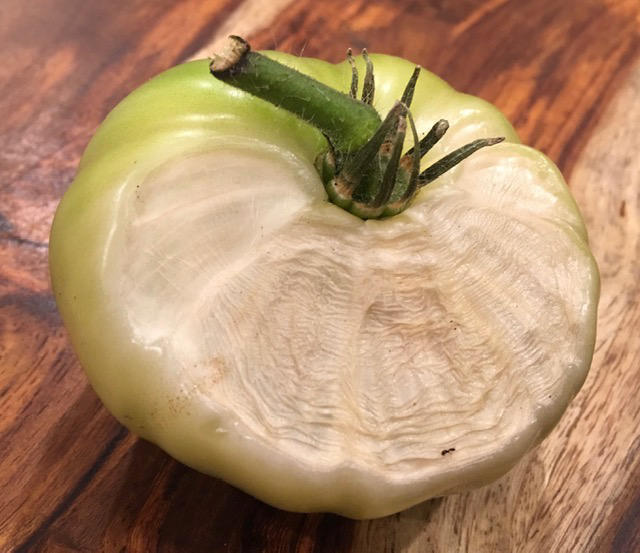
The results of sun scald.
Photo credit Gail Pothour.
Sun Scald: This malady results from fruit getting too much direct sunlight during hot, dry weather. Sun-exposed areas on the fruit overheat and turn yellow or white with a leathery, sunken appearance. The scalded areas may become soft and inedible. If you prune your tomatoes, don’t overdo it. Good air circulation can help prevent fungal diseases and promote ripening, but keep enough foliage to provide some shade to the ripening fruit. Or cover your plants with shade cloth – commercial or homemade with cheesecloth or other thin fabric -- on blistering days.
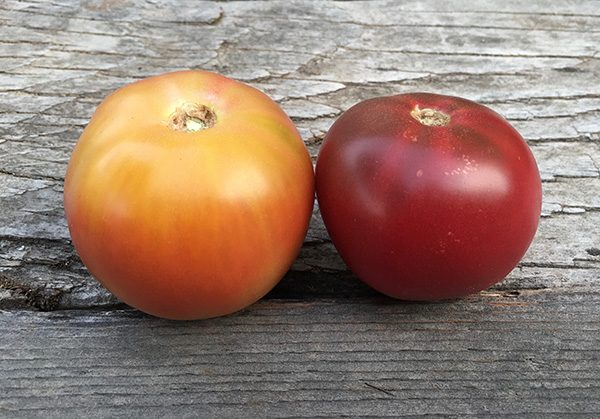
Purple Boy hybrid tomatoes. The left fruit is showing sun yellowing;
the one on the right is the normal ripe color.
Photo credit Gail Pothour.
Solar Yellowing: Another problem, related to sun scald, is solar yellowing, or yellow shoulders. This occurs when fruits are beginning to ripen and temperatures rise above 86 degrees. The side of the tomato exposed to the sun stays firm and turns yellow while the protected side softens and turns to its ripe color. Again, there isn’t enough foliage to protect the fruit. The solution is shade cloth. The ripe part of the tomato, however, is still edible.
In addition to watching for insects or insect damage, inspect your tomato plants regularly for spots, leaf curl, stippling, yellowing, or wilting. Occasionally, whole plants need to be removed and discarded to prevent the spread of disease.
Get identification help from the Master Gardeners’ hotline 775-784-0265, or by email at extensionwashoemg@unr.edu. The help desk, at 4955 Energy Way in Reno, is staffed in person on Tuesday, Wednesday, and Thursday, from 10 a.m. to 4 p.m.
Be prepared to describe your observations and try to take good photos of your plants. If you bring fresh plant materials into the office, put them into plastic bags, and keep different samples separated to keep them free from cross-contamination.
References:
- University of Nevada Reno Extension publication. “Tips for Managing Insect Pests in the Landscape.”
- Utah State University Extension publication. “How to Grow Tomatoes in Your Garden”
- University of Minnesota Extension publication. “Growing Tomatoes in Home Gardens”
- University of Arizona Extension publication.“Tomato Challenges”
A Garden Showcase at Valley Wood Park
Article & photos by Kitty Gillette
Valley Wood Park Wildlife Gardens are a hidden treasure in the northwest area of Reno. It started with the development of a neighborhood that contained, in its center, an undevelopable piece of land that is above an earthquake fault. The City of Reno saw an opportunity to build a 4.6-acre park on this unique piece of land. A play area, walking paths, and turf grass were the dominant features.
But, in 2016, in an effort to reduce water usage, Tom Stille, a local landscape architect and horticulturist, converted an acre of turf into eight unique gardens with the help of a grant from the Truckee Meadows Water Authority. After grant funding ran its course, a new group called the Biggest Little Bee City stepped up to care for this area. In April of 2022, the City of Reno unanimously passed a resolution to become Bee City USA #160, joining a national initiative to protect bees and other pollinators. The program, developed by the Xerces Society, a conservation group, asks cities to agree to reduce the use of pesticides, improve pollinator habitats, and provide public education on the importance of protecting pollinators.
These eight beautiful gardens are now held in trust by Biggest Little Bee City, and the Valley Wood Task Force, made up of multiple local organizations, oversees their care. Volunteer curators guide volunteer workers from Keep Truckee Meadows Beautiful in maintaining the gardens.
Valley Wood Park is located at 6555 Valley Wood Drive in Reno. The gardens are on the east end, right off the street. The first garden you will encounter is the pollinator garden, highlighted with fern bush, firecracker penstemon, lavender, and mock orange. You can walk the mulched trails to be immersed in the variety of pollinator-friendly plants or follow the sidewalk and enjoy the plant life from the perimeter. All the gardens are accessible and wheelchair-friendly. In addition to shelter and food, pollinators need water. Look for the six puddlers placed throughout the gardens, providing water for all forms of wildlife.
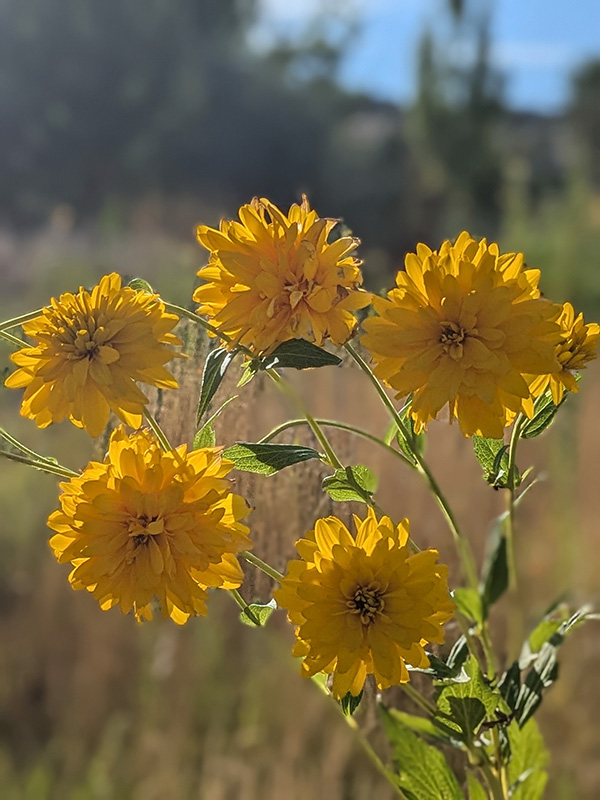
Rudbeckia laciniata ‘Hortensia’ (cutleaf coneflower) was
introduced in the Victorian era. It is a tall perennial with branched stems
bearing double flowers three inches across. It blooms from mid-summer to fall.
Adjacent to and south of the pollinator garden is the butterfly garden. The signature plants for this garden are butterfly bush and showy milkweed, a critical plant to support the monarch butterfly. This garden has been designated a Monarch Way Station by the Monarch Watch Organization, a group that certifies habitats and maps their locations, attracting visitors from around the country.
From this area, you can proceed two ways. An adventurous trail leads through coyote willow and cottonwoods to the riparian garden, or you can follow the sidewalk and turn left to find the herb garden.
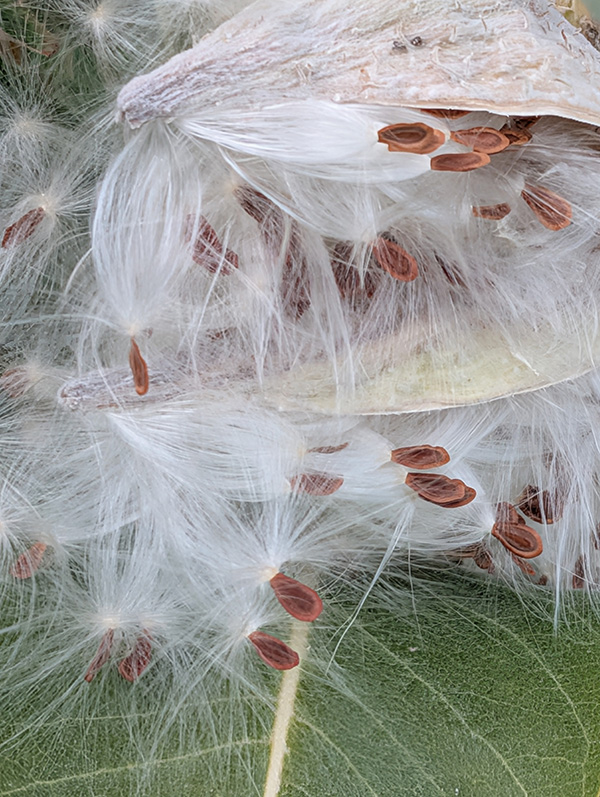
Asclepias speciosa seeds (showy milkweed). This is a host for monarch
butterflies and has clusters of pink flowers when in bloom. The tufts of hair
attached to the seeds are called pappus and enable the seeds to spread by wind.
The herb garden helps show homeowners how they can use existing overhead watering systems to turn turf grass into a garden that supports both pollinators and culinary needs. Here you will find a variety of herbs such as mint, sage, lavender, and amaranth. They are grown in clusters because pollinators prefer to visit flowers that are grown in this way.
Continue south to find even more gardens! At the crossroads, you have the choice of going east along the walking path to enjoy the riparian garden on one side and, on the other side, the beginning of the food forest. The riparian area is meant to look like it has always been there. But observe closely the plant variety, which increases the diversity of the area and demonstrates what plants thrive in such a space.
The food forest has a surprising diversity of plants edible to humans and wildlife: fruit trees, service berries, elderberries, gooseberries, grapes, rhubarb, day lilies, and much more. In the late summer, many people take an evening stroll through the park and pick sun-warmed blackberries as a treat. Be sure you know what you are consuming before you partake!
In this area, you will also find a native and drought-tolerant garden. This important garden showcases plants that help native bees and other native pollinators and wildlife. In May, 30 new native plants were added to the existing flora to attract more native pollinators. Visit any time of year to observe the growth habit of these plants and see how they contribute to the seasonal diversity of the area.
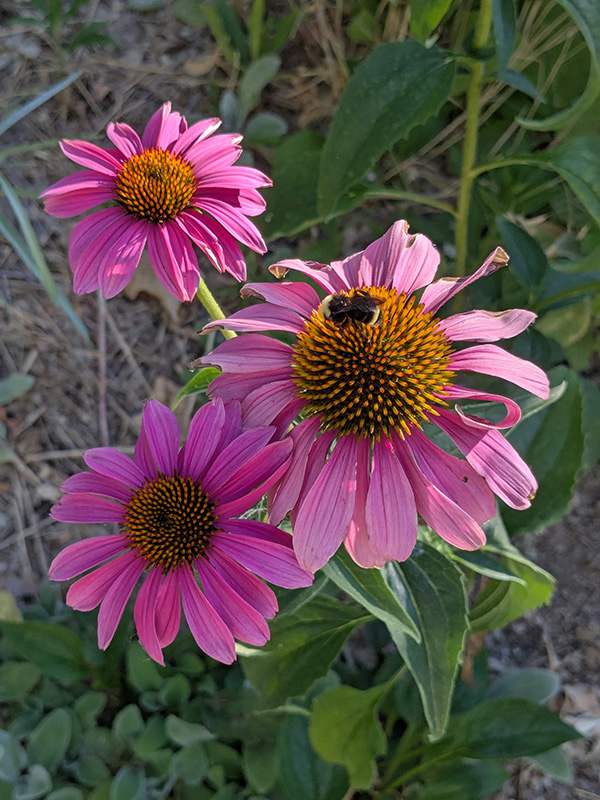
Echinacea purpurea (purple coneflower) with a foraging bumblebee.
Opposite the native garden is the hummingbird garden, which caters to its feathered clientele with many plants that produce red flowers. A recent addition was an eastern redbud. Though the garden targets hummingbirds, it also attracts many types of pollinators. It is always humming with action.
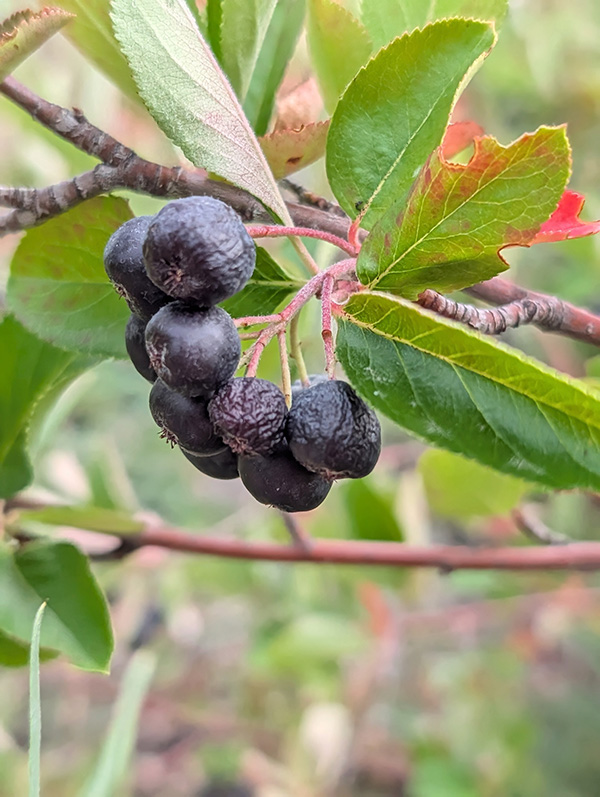
Chokecherries on a Prunus virginian shrub. These berries are a great food source
for birds. Chokecherry shrubs are adaptable to diverse growing conditions and climates.
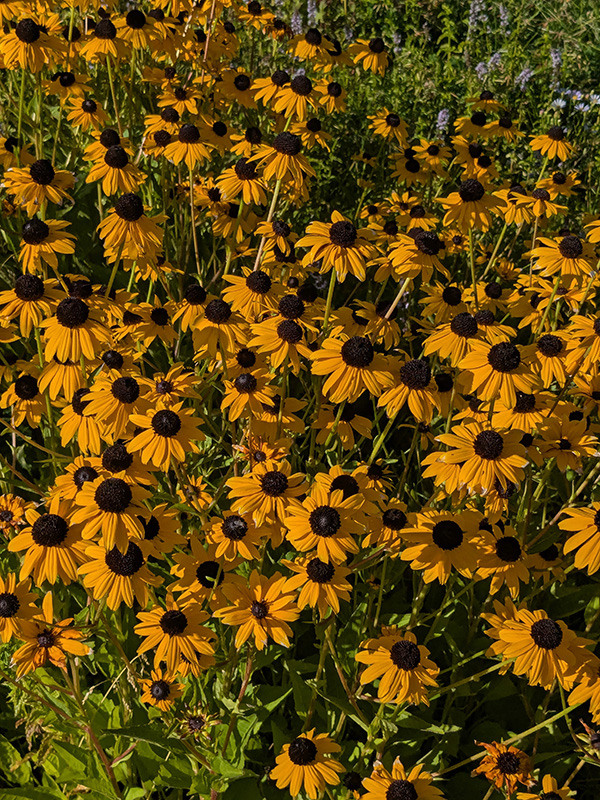
Rudbeckia hirta (black-eyed Susan) has a long blooming season,
and when gone to seed makes excellent food for finches and other seed-eating birds.
In the middle of it all is the pollinator meadow. This garden is overhead-watered, as the design left the original turf grass sprinklers intact, though they do not run as often as they would for traditional turf. The many grasses in the meadow offer four seasons of interest. The hope is to demonstrate to those who want to switch from turf to a diversified lawn to see what can occur. You’ll want to visit the park multiple times to observe seasonal changes that allow this area to feed pollinators and other wildlife year round. One of the signature plants is the lupine. Did you know that lupine supports over 20 different pollinators? Look in this area for the native bee home, which provides tubes for nesting bees. This year mason bees have filled many of the tubes. The surrounding trees and open ground support both ground- and cavity-nesting bees. Nevada has more than 1,000 native bee species. Open ground and native plants provide critical support for them and many other types of pollinators.
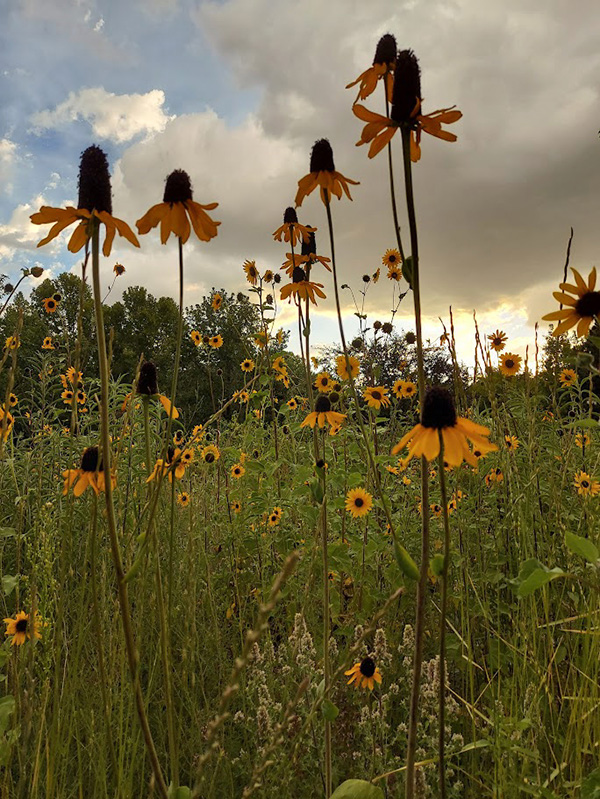
Rudbeckia maxima (giant coneflower) needs
well-draining soil in full sun to partial shade. It is also deer-resistant.
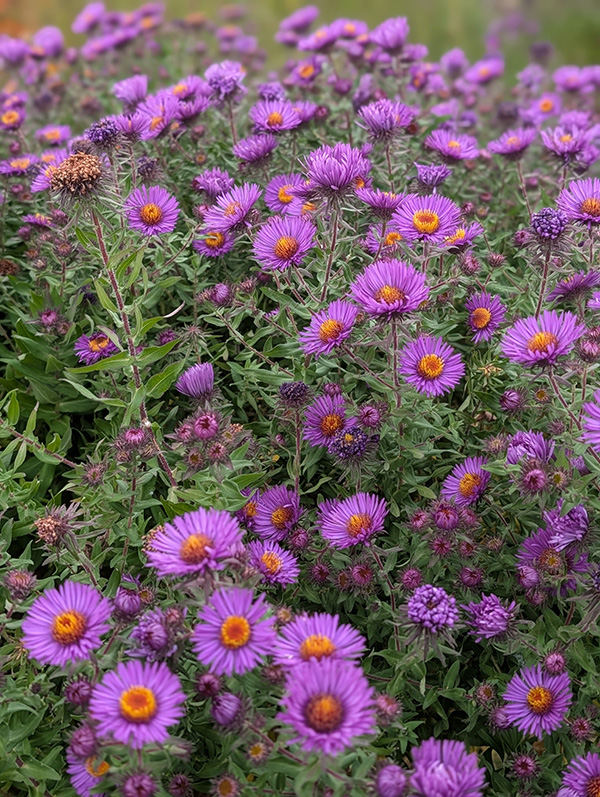
Symphyotrichum spp. (asters) are fall-blooming, and provide
food for pollinators as the summer flowers are waning.
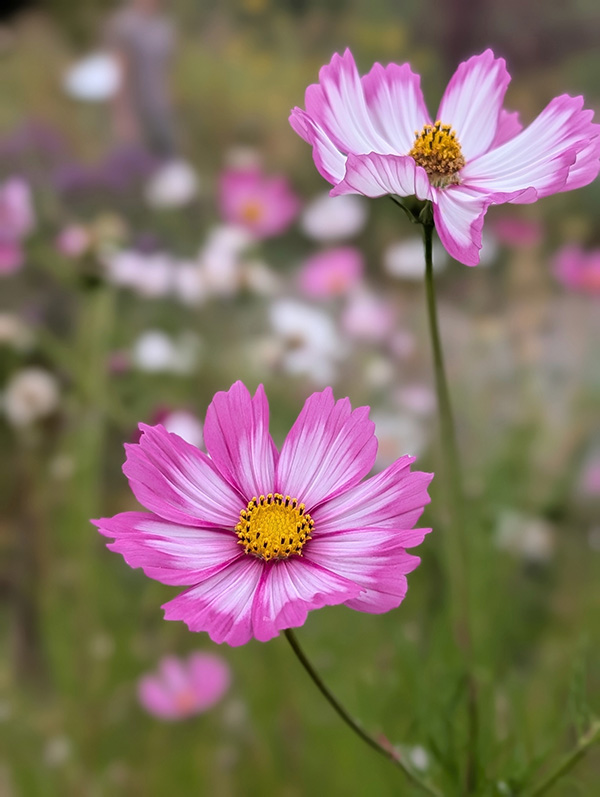
Cosmos spp. (cosmos) bloom from summer through fall and come
in yellow, white, pink, orange, and red. They are annuals, but readily reseed.
Five of the gardens have educational signs developed in partnership with the City of Reno. They can provide more interesting information. But nothing compares to visiting in person. Among the many groups using this area now are preschool groups, the Junior Ranger programs, the Osler Lifelong Learning Institute, and the Nevada Native Plant Society. Formal public tours are held twice a year, guided by Ryan Sharrer, Reno’s city horticulturist. The first of these two-hour tours is at 9 a.m. June 1. The second, at 9 a.m. Oct. 3, will focus on collecting seeds and caring for and germinating them. You can register for these tours at the Biggest Little Bee City web site.
Of course, neighborhood residents regularly enjoy the beauty and changing nature of the area. A common comment from first-time visitors to Valley Wood Park Wildlife Gardens is “I didn’t even know this place existed.” The goal is to change that to “Oh, I need to come here often and bring my friends and family.”
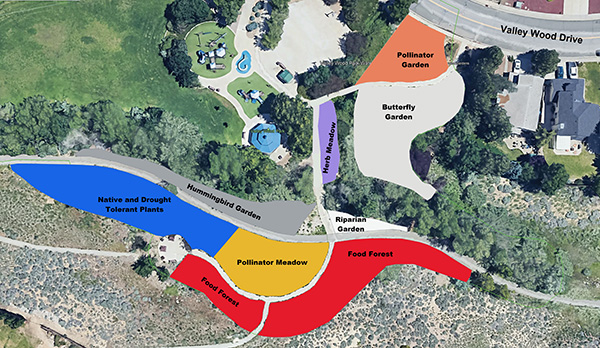
Layout of the Valley Wood Park Wildlife Gardens. (Map by Ray Hopper, Valley Wood Park Task Force)
MG Photo Submissions
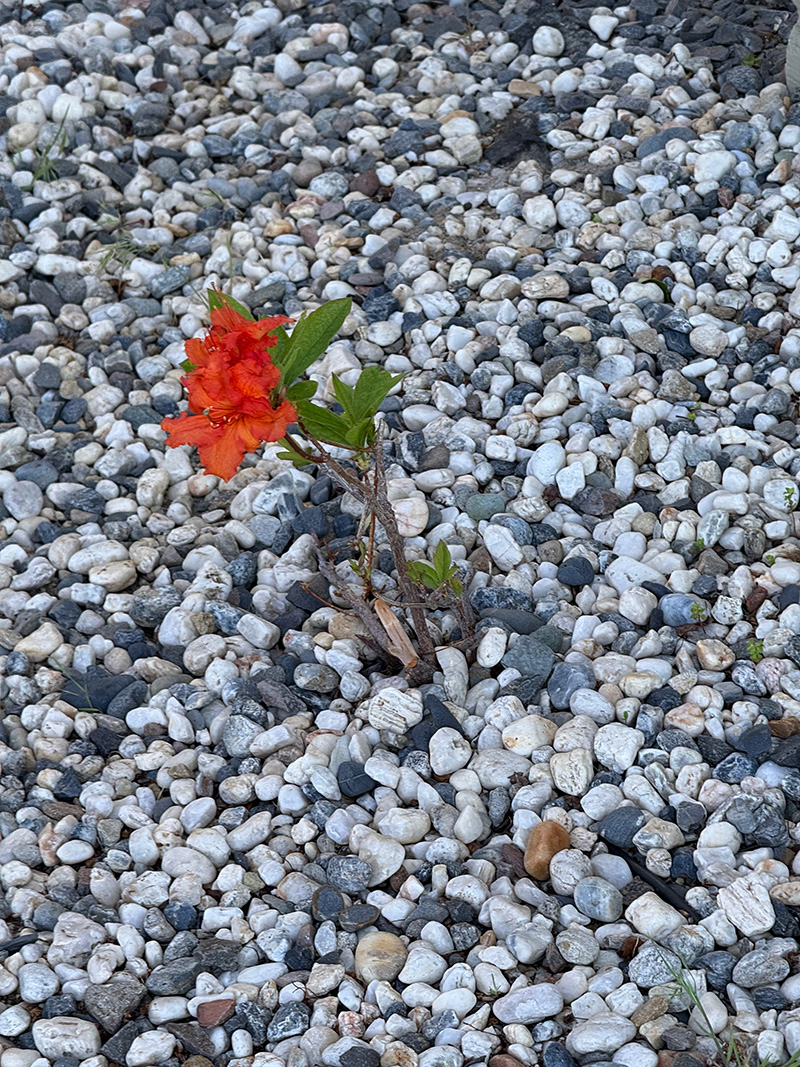
Sun azalea blooming after sustaining bobcat damage
Photo by Anna Anderson
Gratitude:
Talks in the Garden
The University of Nevada, Reno, Extension Master Gardener Volunteer Educator program is full of amazing volunteers who are committed to finding and providing scientifically based, university researched horticultural information for people in our community.
Within our program, we have some special volunteers known as leads. Leads are Master Gardeners who dedicate extra time to organize, plan, and execute tasks related to their project or activity. They commit extra time to the program to lead and mentor other Master Gardener volunteers, and make a huge difference in our community as a whole and especially to the Master Gardener program.
One of the ways we provide information to the public is through the Third Thursday Talks, held at the Rancho San Rafael Teaching and Demonstration Gardens from May through September. These talks cover a myriad of gardening topics relevant to local gardeners. They are interactive, often using plants and props from the garden. Deborah (Deb) Whitehouse is the lead who coordinates the talks, ensuring they are fun, educational, and pertinent to what is going on in the garden. Let’s take a minute to get to know Deb from a recent interview:
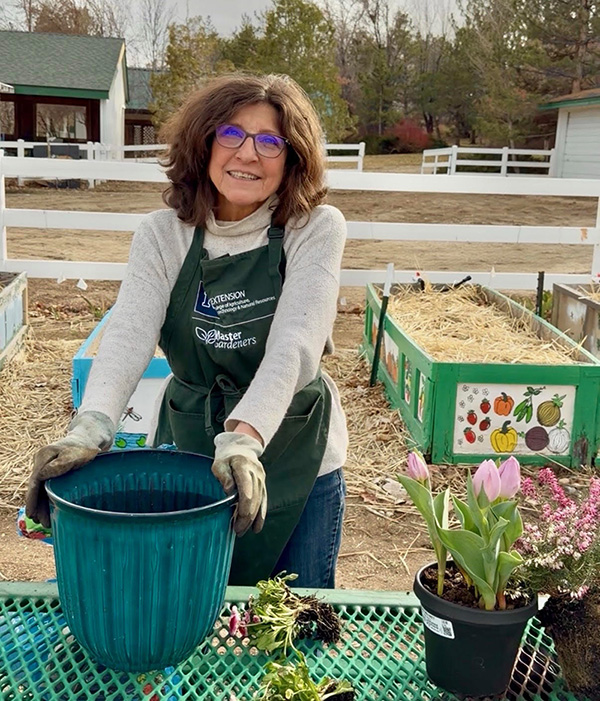
Deb Whitehouse working at Rancho San Rafael
community garden. Photo credit Angela White.
Q. What sparked your interest in gardening?
My mother. She used to drag me out to our vegetable garden in Florida to weed. There I fell in love with being in the garden. I was fascinated by the plants and the bugs.
Q. What is your gardening passion?
My passion is how gardening helps us do our part for the planet. I enjoy feeding the soil, improving the environment, and providing food for those in need. My favorite thing is to watch the plants grow.
Q. How has the Master Gardener Program scientifically helped you in your garden?
It has helped me understand the ecosystem, the water cycle, and how plants provide habitats and food for the bugs/birds/etc. It has also helped me understand the difference between pests and beneficial insects/bugs and how to recognize them.
Q. What makes you smile about the Master Gardener Program?
The people in the program, I love them all!
Q. Share a meaningful Master Gardener volunteer experience.
At the South Valley Library, I was teaching a class about plant propagation, and one child raised his hand and enthusiastically asked, “Is this about plant sex?”
Q. One word to describe the Master Gardener Program.
Multifaceted.
Q. Describe your project.
The Third Thursday Talks are a key part of the “teaching” that goes on in the Community Garden at San Rafael Regional Park. Master Gardeners and interns provide information to the public on many gardening topics.
Q. What is your vision for your project?
To expand the audience, to explore topics the public is interested in, and to have the speakers connect the Rancho San Rafael Garden to their topic.
Q. How will you put that vision into practice?
By working with the rangers, Washoe County Parks, and UNR Extension to expand advertising of the Third Thursday Talks. And by surveying the attendees to understand their interest level in various topics.
Q. How does your project benefit the community?
We bring the public-facing aspect of the Master Gardener program to life by interacting directly with the public on many levels. The talks provide knowledge and information to people who are curious about starting a garden, planting their first plant. We also help people who have very specific questions about how to solve problems in their gardens.
Q. What keeps you involved in the Master Gardener program?
The camaraderie, the exercise, and the learning.
Q. What would you like others to know about your project that they likely don't know?
If you attend the Third Thursday Talks, you get to experience the entire Rancho San Rafael Demonstration and Teaching Garden in the Community Gardens. This garden donates 700 to 800 pounds of produce each year to the Reno/Sparks Gospel Mission.
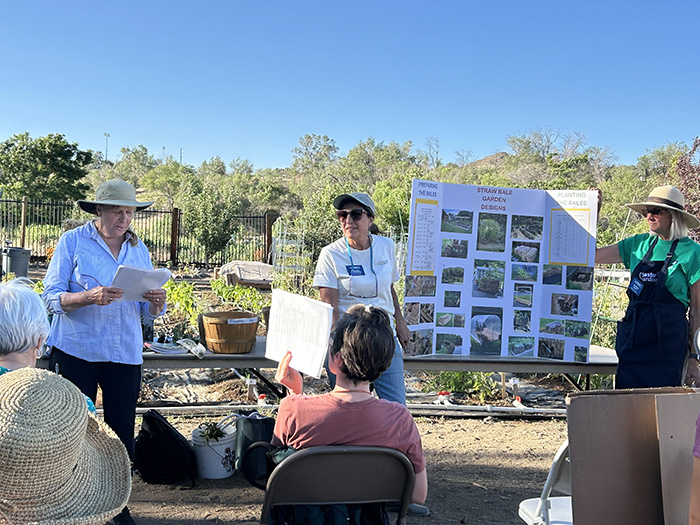
One of many presentations given at the Third Thursday talks.
Creating a Pollinator-Friendly Garden
Article & Photos by Leslie Edgington
Ensuring that your garden is pollinator-friendly can make a big difference in its health and sustainability, as well as your enjoyment of it.
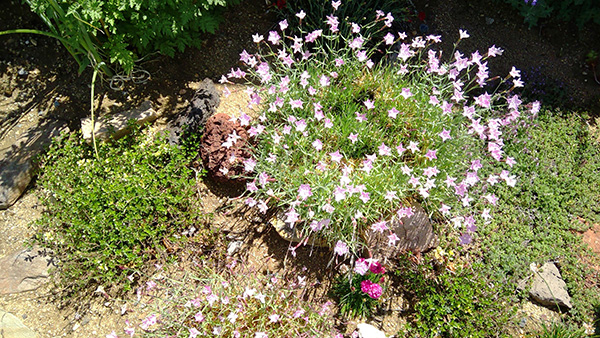
The pink-tinged flowers of dianthus (Dianthus spp.) do well in temperatures 85 degrees F.
and below, but will go dormant in the high heat of summer. It attracts butterflies
and other pollinators because of its high nectar content.
A pollinator is anything that moves the pollen from the anthers to the stigma of a plant. The anther is the male part of the plant, and the pistil is the female, or seed-producing, part (the stigma is the sticky part of the pistil that can capture pollen). Insects are the main pollinators, but birds, humans, the wind, small animals, and anything else that comes into contact with plants can perform this function.
Different kinds of pollinators need different kinds of habitats. In order to welcome insects into your garden, there are a number of considerations to make: First, a source of water is important. While a bird bath is great for birds, it will likely be too deep for insects – and you may find lots of them drowned in it! A better solution for insects is a saucer filled with water and some rocks. The insects can land on the rocks to access the water without falling into it. Keep the water fresh by refilling it often.
Having some amount of bare ground is important for attracting many insects, including solitary bees like bumble bees, make their nests in the ground, including in holes left by other animals. They spend the winter in the ground, too. Some native bees, like mason bees, need mud to build their nests. Butterflies also need a patch of damp ground for healthy living.
Consider maintaining a small area with a leaf pile or small branches pruned from trees. Such an area can provide nesting sites for insects and places for them to overwinter. Some gardeners prefer to make or purchase insect hotels, which are great, but be sure to clean them every year, or insects won’t return to them.
An obvious way to encourage insects to live in your garden is to limit the use of pesticides. If you can live with some imperfection, that is better than killing the very things you want more of. There are a lot of ways to deter nuisance bugs without using pesticides.
Finally, planting lots of flowering plants attracts insects. Try to ensure that you have plants blooming throughout the spring, summer, and fall. Having a succession of flowering plants will benefit insects year-round. Of course, there are thousands of wonderful flowering plants to choose from. Some popular spring-blooming flowers are tulips, hyacinths, alliums, nepeta, moss phlox, snow in summer, and pansies. Summer-blooming flowers include phlox, penstemons, zinnias, petunias, cosmos, gaura, lavender, and agastache. Fall-blooming plants include black-eyed Susans, salvias, nepeta, and petunias.
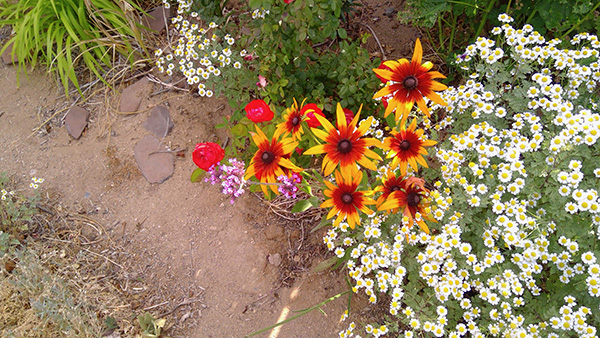
The red and yellow flowers are black-eyed Susans (Rudbeckia spp). The white flowers are
feverfew (Tanacetum parthenium.) Both bloom from July to October. While black-eyed Susans
attract pollinators, feverfew is not a favorite plant of bees.
Make your garden a good food source and home for pollinators, and they will not only entertain you, but also ensure that your garden grows and blooms!
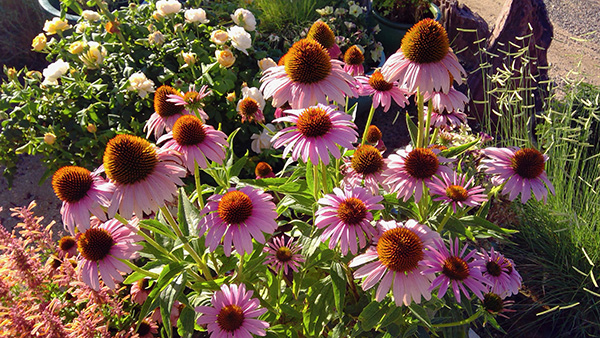
Purple coneflower (Echinacea purpurea) thrives in hot,
dry conditions, and blooms in the summer months.
Questions or comments?
Reach out to us!
Help Desk Hours: 10 a.m. - 2 p.m. Tuesdays, Wednesdays & Thursdays
Phone: (775) 784-4848
Email: ExtensionWashoeMG@unr.edu
Rachel McClure Master Gardener Coordinator
Phone: (775) 336-0274
Email: rmcclure@unr.edu
How to become a Master Gardener
WASHOE COUNTY MASTER GARDENER EVENTS
MASTER GARDENER HELP DESK
Published by:
McClure, R., Colwell, B., Doolittle, C., 2026, Washoe County Master Gardener Newsletter (2026-06), Extension, University of Nevada, Reno, Newsletters
An EEO/AA Institution. Copyright © 2026, University of Nevada Cooperative Extension.
A partnership of Nevada counties; University of Nevada, Reno; and the U.S. Department of Agriculture