Why Nevada?
Solar development in Nevada is projected to increase 10,659 mega watts by 2030. Such growth will require the development of over 39,000 acres of land in just five years to host these projects [1]. With an abundance of sunshine, Nevada is an appealing location for solar development. Northern and central Nevada average between 237 and 274 days of sunshine per year and southern Nevada averages over 292 days annually [2]. Yet, traditional solar development permit applications are frequently met with public and local jurisdiction opposition for reasons that include a lack of land stewardship and community benefits. Agrivoltaic and ecovoltaic systems offer strategies that could support the state’s energy and sustainability goals [3], while generating public support for these scalable co-production systems that range in size from small community solar gardens to utility-scale operations.
Meeting Energy Demands Sustainably and Responsibly
The increasing demand for energy solutions, coupled with public opposition due to concerns over land use and the impact on ecosystems, has driven the emergence of innovative strategies that combine solar energy generation with agricultural practices and conservation efforts. Agrivoltaics and ecovoltaics are two such approaches that have optimized land use, enhanced food security, and mitigated the environmental consequences of conventional large-scale solar energy development in other states [4,5]. There are currently no known agrivoltaic systems in Nevada, leaving the pathways open for demonstration sites, research and creative permitting solutions [6].
How Can Co-production Solar Projects and Community Benefit Agreements Help?
Solar photovoltaic (PV) system priorities can be categorized in two ways: single-priority and co-priority.
Single-priority Solar Photovoltaic Project
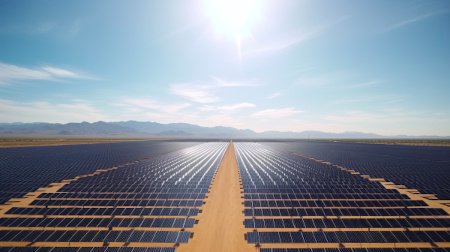 © Solar Farm, Filip
Co-priority Solar Photovoltaic Project
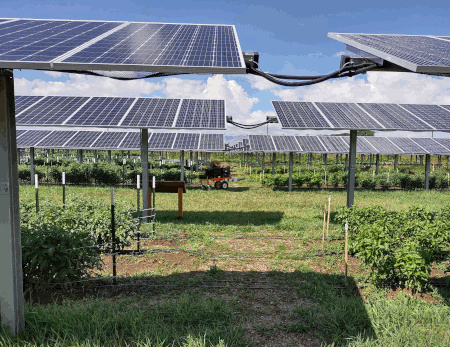
© Agrivoltaics at Jack’s Solar Garden, Misha Allen
Single-priority solar photovoltaic systems operate within business models that prioritize solar energy generation, with the land being utilized for its singular purpose. Solar to electricity power generation is their singular focus and product. Conventional solar installations are an example of single priority systems.
Co-priority solar photovoltaic systems operate within business models with two or more shared priorities, one of which includes solar energy generation. These co-priority projects are also frequently referred to as co-production or co-located systems. They consist of operations co-located on the same land and footprint, utilized for two or more purposes [8]. There are a variety of co-priority or co-production solar photovoltaic systems, including agrivoltaics and ecovoltaics [9].
Co-priority projects can address the land use, land stewardship and environmental impact concerns that result in community opposition to single-priority solar projects. The public’s opposition based on community benefit concerns can be addressed through community benefit agreements.
A community benefit agreement outlines how a project will function within a community and support its well-being. It is cocreated between a project owner and community representatives from each community it impacts. The agreements are a dynamic and engaging process that guides the project’s community investment based on locally identified needs, garnering community support for projects. This tool can be initiated by the community, government, or project owner [10, 11, 12, 13].
Together, co-priority solar photovoltaics projects and these agreements could address public opposition to solar development in their communities.
What Are Agrivoltaics and Ecovoltaics?
Agrivoltaic systems utilize photovoltaics over, and in conjunction with, agricultural activities (farming, ranching) to grow crops and/or graze livestock. The synergetic interactions between the solar panel framework and crops create a cooler microclimate that directly impacts agricultural activities, reducing water requirements. Solar energy generation and agricultural products are coproduced on the same area of land [14, 15].
Agrivoltaic Systems
Co-priority solar projects with agricultural production (crops and/or livestock) 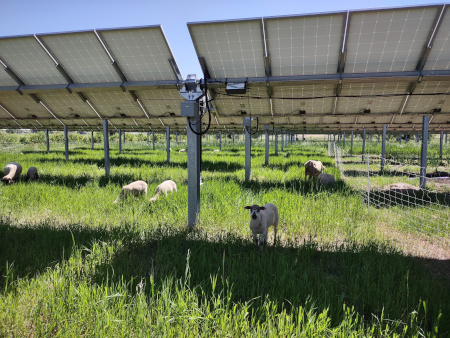
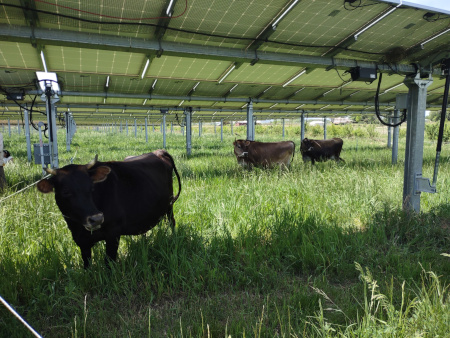
© Agrivoltaics with forage production and livestock grazing at Jack’s Solar Garden (Longmont, Colo.), Misha Allen
Ecovoltaic systems utilize photovoltaics over, and in conjunction with, the conservation, preservation and enhancement of natural habitats, ecosystem and rangeland services [16]. The integration of these systems can provide multiple benefits, including increased land-use efficiency, improved water management, enhanced agricultural productivity and the conservation of sensitive ecosystems [15,16].
Ecovoltaic Systems
Co-priority solar projects with conservation, ecosystem, or rangeland services
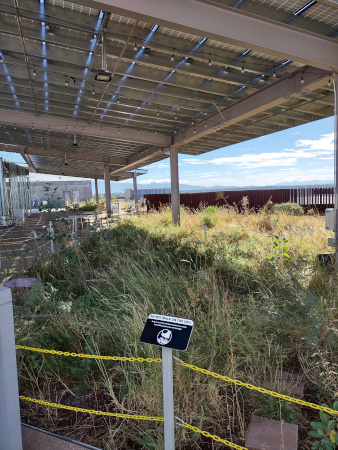
© Ecovoltaics at University of Arizona, Tucson; Green Rooftop Project (native plants), Misha Allen
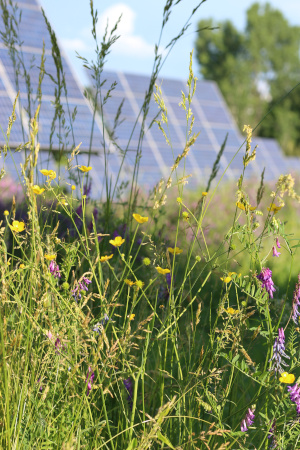
© Ecovoltaics (pollinator habitat), Pia
How Local Jurisdictions Can Help
County-level permitting processes can play a crucial role in the adoption of these integrated systems by incorporating specific criteria and incentives that prioritize agrivoltaic or ecovoltaic projects while increasing direct community benefit and public support. Ordinances and incentives can emphasize jurisdictional priorities.
How Might Nevada’s Counties Incentivize Agrivoltaic and Ecovoltaic Systems?
Possible pathways to consider include developing a permit application ranking process, with preference points awarded to applicants that incorporate desired components, such as:
- Agrivoltaic or ecovoltaic systems
- Voluntary community benefit agreements [11, 12, 13]
- Engage community members in the economic development and planning process.
- Talk to your legal team about potentially incorporating the agreement into the development agreement, or other relevant legally binding document, that would transfer with any sale of the project.
How to Get Started
Development of a county process that prioritizes agrivoltaic and ecovoltaic system adoption and deployment would ideally incorporate a multidepartment and interagency team to include natural resources, sustainability, permitting, building and planning, county attorneys, community development specialists, and other relevant experts. A half-day, in-person workshop could provide foundational information to launch the work group’s collective efforts, to include:
- Introduction to Agrivoltaics in Western States (University of Nevada, Reno Extension)
- Introduction to Community Benefit Agreements - includes creating sample provisions (UNR Extension)
- Introduction to Permitting Processes (relevant jurisdiction)
- Introduction to Development Agreements (relevant jurisdiction)
- Small and Large Group Work for Solution Development (UNR Extension + relevant jurisdiction)
Resources
Additional publications, including community benefit agreement resources [11, 12, 13], are available within this Economic and Community Development Education Series through the University of Nevada, Reno Extension library. Publications are searchable by author names here: https://extension.unr.edu/publications.
References
- Solar Energy Industries Association. (2025). NV Solar State Spotlight. Solar Energy Industries Association.
- Western Regional Climate Center. (2025). Climate of Nevada. Western Regional Climate Center. Retrieved 05/20/25
- State of Nevada. (2025). NRS 704.7801 Portfolio Standard. Public Utility Commission. Retrieved 05/20/25
- Pascaris, A. S., Schelly, C., Burnham, L., & Pearce, J. M. (2021). Integrating solar energy with agriculture: Industry perspectives on the market, community, and socio-political dimensions of agrivoltaics. Energy Research & Social Science, (2025).75(C), 102023
- Hernandez, R. R., Hoffacker, M. K., Murphy-Mariscal, M. L., Wu, G. C., & Allen, M. F. (2015). Solar energy development impacts on land cover change and protected areas. Proceedings of the National Academy of Sciences - PNAS, 112(44), 13579–13584.
- Open EI. (2025). Agrivoltaics Map. InSPIRE. Retrieved from: https://openei.org/wiki/InSPIRE/Agrivoltaics_Map
- Warmann, E., Jenerett, G. Barron-Gafford, G. (2024). Agrivoltaic system design tools for managing trade-offs between energy production, crop productivity and water consumption. Environmental Research. Retrieved from: https://unr.primo.exlibrisgroup.com/permalink/01UNR_INST/adtd5q/cdi_crossref_primary_10_1088_1748_9326_ad2ab8
- Congressional Research Service. (2024). Dual-Use Solar Photovoltaics - Emerging Applications & Issues for Congress. Targeted News Service.
- Kominek, B. (2023). Sharing Terminology. Colorado Agrivoltaic Learning Center. Email correspondence.
- Gross, J., LeRoy, G. and Janis-Aparicio, M. (2005). Community Benefits Agreements: Making Development Projects Accountable. Good Jobs First and the California Partnership for Working Families.
- Allen, M. (2025). Community Benefit Agreements: Enhancing Engagement and Aligning Values Between Nevada’s Communities and Industries (Economic and Community Development Education Series, No. 1). University of Nevada, Reno Extension. https://extension.unr.edu/publications.aspx
- Allen, M. (2025). Community Benefit Agreements: Resources for Communities, Government, and Industries (Economic and Community Development Education Series, No. 2). University of Nevada, Reno Extension. https://extension.unr.edu/publications.aspx
- Allen, M. (2025). Community Benefit Agreements: Engaging Communities and Industries for Mutual Benefits (Economic and Community Development Education Series, No. 3). University of Nevada, Reno Extension. https://extension.unr.edu/publications.aspx
- Dinesh, & Pearce, J. M. (2016). The potential of agrivoltaic systems. Renewable & Sustainable Energy Reviews, 54, 299–308. Retrieved from: https://doi.org/10.1016/j.rser.2015.10.024
- Toledo, C., & Scognamiglio, A. (2021). Agrivoltaic Systems Design and Assessment: A Critical Review, and a Descriptive Model towards a Sustainable Landscape Vision (Three-Dimensional Agrivoltaic Patterns). Sustainability, 13(12), 6871-. https://doi.org/10.3390/su13126871
- Ghosh, A. (2023). Nexus between agriculture and photovoltaics (agrivoltaics, agriphotovoltaics) for sustainable development goal: A review. Solar Energy, 266, 112146-. https://doi.org/10.1016/j.solener.2023.112146