Introduction
With the accelerating pace of urbanization, escalating climate change, and steady loss of arable land, the world is witnessing a growing interest in alternative farming methods to feed the future generations. According to statistics1 food production must rise by at least 70% to feed an estimated 9.7 billion people by 2050. Since conventional agriculture relies heavily on freshwater supplies, fertile land, and favorable weather, is rapidly approaching its limits. To address these global issues, vertical farming (VF) has arisen as a potential and innovative solution in modern agriculture. VF is positioned at the core of controlled environment agriculture (CEA) which redefines how, where, and when food is produced2.
Definition of Indoor Vertical Farming
Definition of Vertical Farming: “Vertical farming is the practice of producing food in vertically stacked layers, often incorporating controlled-environment agriculture (CEA), which optimizes plant growth and soilless farming techniques such as hydroponics, aquaponics, and aeroponics” according to Despommier, 2010, a prominent VF influencer3.
Indoor Vertical Farming refers to the practice of growing crops in vertically stacked layers within a controlled environment, such as buildings, shipping containers, or warehouses. Unlike traditional agriculture, vertical farming leverages vertical space by stacking crops in multi-layered systems and optimizing growth conditions through precise control of light, temperature, and nutrients. VF maximizes productivity, minimizes resource use, and protects crops from environmental stressors4.
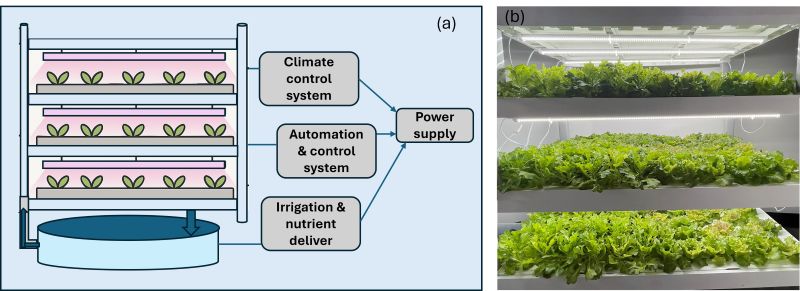 Figure 1. (a) Schematic diagram of an indoor vertical farming system; (b) Indoor vertical farming at the University of Nevada, Reno (UNR Extension in Las Vegas).
Unlike soil-based conventional agriculture, VF employs soilless cultivation systems such as hydroponics (e.g., deep water culture, nutrient film technique, aeroponics), aquaponics, and substrate-based growing methods. These technologies enable exceptionally high productivity with yields reported to be 10–20 times greater per unit area than open-field cultivation5,6.
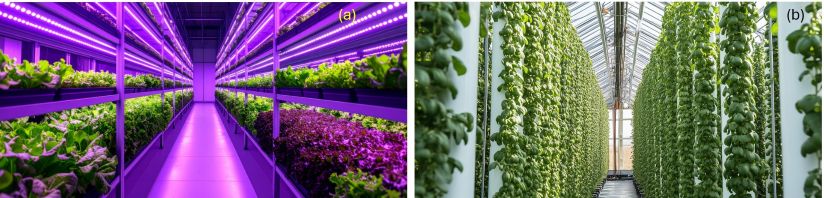 Figure 2: (a) Container farming; (b) Tower farming
Advantages:
VF enables local, year-round crop production, significantly reducing food miles, transport emissions, and supply-chain vulnerabilities5,6 . At the community-scale VF can help alleviate food insecurity in underserved neighborhoods while creating local employment opportunities and supplying fresh produce7. The sustainability benefits of VF include up to 99% less land use, reducing water consumption by up to 90%, minimal pesticides, and reduced transport-related GHG emissions8,9.
Challenges:
Despite its transformative potential, VF faces several technical, economic, and operational challenges that currently constrain large-scale adoption and profitability, These are:
- High energy consumption and costs:
Environmental regulations and artificial lighting are the largest operational expenses. Lighting systems alone typically consume 200-400 kWh/m² per year, translating to 10-20 kWh per kilogram of produce 9,10.
- Large capital outlay:
Establishing commercial-scale VF facilities required substantial upfront investment ranging from $10-30 million for medium to large facilities2.
- Narrow crop portfolio:
Current vertical farming models remain economically viable primarily for high-value, fast-growing crops such as leafy greens, microgreens, and herbs., whereas staple crops (e.g., grains, tubers, and fruits) pose technical and economic constraints due to their longer growth cycles, higher light and space requirements, and lower market price per unit biomass4,5.
- Workforce requirements:
To operate, VF requires interdisciplinary expertise spanning horticulture, plant physiology, engineering, data analytics, and automation control. The lack of trained personnel capable of integrating biological and technological aspects remains a key operational bottleneck11.
Prospect and global market expansion
The global vertical-farming sector was valued at approximately USD 6.9 billion in 2024, and it is projected to reach roughly USD 50.1 billion by 2032 implying a compound annual growth rate (CAGR) of about 28.8% over the forecast period.
Future directions for vertical farming
Future directions for vertical farming will focus on bio-based fertilizers, ion-specific nutrient monitoring, precision fertilization, environmental control, and stress adaptation to enhance nutrient efficiency. The greater emphasis will be placed on automation, artificial intelligence, and robotics for optimized environmental control and stress adaptation. Expanding beyond leafy greens, future systems should target medicinal, nutraceutical, cereal, tuber, and fruiting crops through specialized breeding. Moreover, workforce development in horticulture, engineering, and data analytics will be essential to sustain innovation in next-generation vertical farming.
Reference:
- United Nations. (2019). World Population Prospects 2019: Highlights. Department of Economic and Social Affairs, Population Division
- Benke, K., & Tomkins, B. (2017). Future food-production systems: Vertical farming and controlled-environment agriculture. Sustainability: Science, Practice and Policy, 13(1), 13–26.
- Despommier, D. (2010). The Vertical Farm: Feeding the World in the 21st Century. Thomas Dunne Books, New York, USA.
- Kozai, T., Niu, G., & Takagaki, M. (2020). Plant Factory: An Indoor Vertical Farming System for Efficient Quality Food Production (2nd ed.). Academic Press, London.
- Beacham, A. M., Vickers, L. H., & Monaghan, J. M. (2019). Vertical farming: A summary of approaches to growing skywards. Journal of Horticultural Science & Biotechnology, 94(3), 277–283.
- Kozai, T., Niu, G., & Takagaki, M. (2020). Plant Factory: An Indoor Vertical Farming System for Efficient Quality Food Production (2nd ed.). Academic Press, London.
- Kalantari, F., Tahir, O. M., Lahijani, A. M., & Kalantari, S. (2017). A review of vertical farming technology: A guide for implementation of building integrated agriculture in cities. Advanced Engineering Forum, 24, 76–91.
- Al-Kodmany, K. (2018). The vertical farm: A review of developments and implications for the vertical city. Buildings, 8(2), 24
- Graamans, L., Baeza, E., van den Dobbelsteen, A., Tsafaras, I., & Stanghellini, C. (2018). Plant factories versus greenhouses: Comparison of resource use efficiency. Agricultural Systems, 160, 31–43.
- Barbosa, G. L., Gadelha, F. D. A., Kublik, N., Proctor, A., Reichelm, L., Weissinger, E., Wohlleb, G. M., & Halden, R. U. (2015). Comparison of land, water, and energy requirements of lettuce grown using hydroponic vs. conventional agricultural methods. International Journal of Environmental Research and Public Health, 12(6), 6879–6891.
- Kalantari, F., Tahir, O. M., Lahijani, A. M., & Kalantari, S. (2017). A review of vertical farming technology: A guide for implementation of building integrated agriculture in cities. Advanced Engineering Forum, 24, 76–91.