Preventing Short-Term Illness
Illness and Older Adults
Do you remember the last time you were sick? If your symptoms included fever, vomiting, or diarrhea chances are very high that germs were involved. A person over the age of 65 is two to three times more likely than a younger adult to get pneumonia. In an older adult, pneumonia and influenza (the "flu") can be life threatening. Older adults with the flu are more likely to get pneumonia or other serious infections.
These illnesses can be much more severe and difficult to treat for those over age 60. The risks of getting many potentially dangerous short-term illnesses, such as the flu, pneumonia, and colds can be reduced.

Hand Washing -- The Secret Weapon
The most important thing we can do to prevent the transmission of infectious organisms is to wash our hands often.
The role of germs
Not all germs are harmful. Many of them live in our bodies, and some even help us. Germs are often picked up and transferred by touching things and people with our hands. Some viruses, such as those associated with the common cold, can jump from person to person by touch, by air, or by contacting a contaminated surface.
Some germs that get passed among people live only briefly on the skin, and a healthy immune system fights them off. Other germs are more harmful, especially to those who have weakened immune systems. The immune systems of older adults are not as strong as those of younger adults.
Germs include viruses and bacteria. The flu and the common cold are caused by viruses. Some types of pneumonia are caused by bacteria and others by viruses.
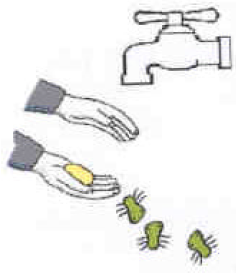
How To Wash Hands
Use soap and warm water. Warm water cuts through grease faster than cold water.
Soaps
The main function of soap is to create a slippery environment for microorganisms, so that they rinse off. Regular soap gives you essentially the same effect as antibacterial soap-the microorganisms are loosened then washed away. Antibacterial soaps can be more expensive and may cause skin irritation. However, any soap can irritate or dry out skin-so keep some hand lotion nearby.
- Rub soapy hands together at least 20 seconds before rinsing. Your goal is to loosen dirt and germs.
- Try counting out loud: ("1 Mississippi, 2 Mississippi…. through 20 Mississippi"). Or sing "Happy Birthday to you" twice.
- Wash backs and palms of hands. Soap and scrub between fingers, around and under fingernails. Take rings off. Nailbrushes are great.
- Rinse all of the soap off your hands.
- It's best to dry hands on a paper towel because you can throw it away after you use it.
When To Wash Hands
- After contact with publicly used devices such as ATM's, grocery carts, and doorknobs.
- Before food preparation.
- After touching animals or changing a litter box.
- After touching food, especially raw meat and raw poultry.
- After using the bathroom (or changing diapers).
- After sneezing, coughing or blowing your nose.
- After gardening.
- After handling money.
- After handling garbage.
Avoiding Tobacco Smoke
Another way to reduce your risks for getting short-term illnesses is to avoid tobacco smoke.
Active smoking: Smokers have a higher risk than non-smokers of getting respiratory illness including pneumonia, the flu, and colds.
Passive smoking: If you are around others in homes or businesses when they smoke, breathing in second-hand smoke, you are at higher risk for a number of illnesses.
Flu and Pneumonia Shots
People age 50 and over who are not allergic to eggs should get a flu shot every year by mid-November.
People age 65 and older should get the pneumonia shot. Most people need the pneumonia shot only once. Some may need a booster shot 5-10 years later.
There may be some relatively minor side effects from a flu or pneumonia shot such as a low fever or redness around the site of the injection or some mild aches and pains. A flu or pneumonia shot cannot cause the flu by itself. For most people, the danger of becoming ill, and possibly contracting pneumonia as a result of having the flu, are much greater than from side effects from the vaccines.

Immunization Tips
You can get the flu shot and the pneumonia shot at the same time.
Both are available through doctors' offices and the health department.
Medicare Part B pays for pneumonia and flu shots.
Keep a personal written record of any immunizations you get.
References
Lipman, M. M. (1999, February). Don't Catch Your Death of Pneumonia. Consumer Reports on Health, 11, 11.
Massachusetts Water Resources Authority. (2000). Water and Germs (Online): MWRA.
National Cancer Institute. (1999). Health Effects of Exposure to Environmental Tobacco Smoke.
National Institute of Allergy and Infectious Diseases. (1997). Flu. (Online): NIH.
National Institute on Aging. (1994). Shots for Safety. (Brochure). Gaithersburg, MD.
Schulman, S.T., Phair, J.P., Peterson, L.R. & Warren, J.R. (1996). The Biologic and Clinical Basis of Infectious Diseases (5th ed.). Philadelphia: W.B. Saunders Company
Published by:
Collins, C. and Schmidt, N., 2001, Preventing Short-Term Illness, Extension | University of Nevada, Reno, FS-01-42
An EEO/AA Institution. Copyright © 2026, University of Nevada Cooperative Extension.
A partnership of Nevada counties; University of Nevada, Reno; and the U.S. Department of Agriculture