A healthy lawn has fewer weeds.
Are weeds in your lawn driving you crazy? Do you struggle to eliminate them from your lawn each year? Perhaps you’re not addressing the root of the problem.
The best defense against lawn weeds is a healthy lawn.
Healthy lawns are thick, have deep roots and enough resilience to handle summer heat. Thin or patchy lawns are easily invaded by weeds.
If you already have weeds, start to solve your weed issues by figuring out why your lawn is stressed and what you can do about it.
Manage the occasional weeds.
For best success, tackle weeds early. Keep an eye on your lawn and remove weeds when they first appear.
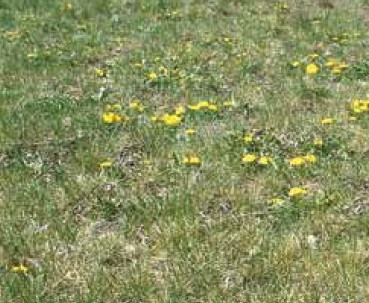
Try traditional tools.
Hand-pulling and digging are time-honored tools that work particularly well for annual weeds. Annual weeds live only one year and produce seed for next year’s crop. Can’t identify your weeds? Bring a sample, ideally the entire plant including the roots, to your local University of Nevada Cooperative Extension office, or email good-quality photos (see page 2 for locations and emails). We’ll identify the weeds and give you suggestions for the safest ways to control them.
Some weeds grow back from the roots.
If you’ve ever tried to dig out a dandelion, you know it’s a challenge! Dandelions are perennials. They grow back from the roots each year. To control dandelions and other perennials by hand, dig as much of the root as possible. Revisit the spot regularly and dig out weeds if they regrow. There are tools available to help remove weeds that have taproots, or you can use a shovel or wide-bladed screwdriver.
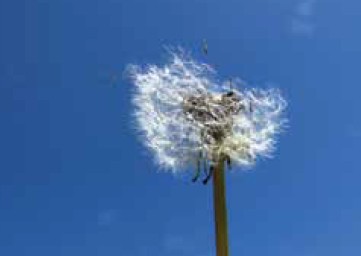
Sometimes herbicides are needed.
You’ve de-stressed your lawn by watering deeply and evenly, mowing high and fertilizing appropriately. If you still have more weeds than you can remove by hand, you may need to use a pesticide that kills weeds, called an herbicide. There are many choices available on the market. They vary in several ways. Before you select a product, read the entire label carefully, and make sure it can be used in a lawn. Pick a product that works on the specific weeds, breaks down quickly and has the lowest toxicity. Look for the signal word “CAUTION” on the front label of the herbicide. You must follow the label directions exactly.
Selective vs. non-selective herbicides
Some herbicides are selective, meaning they are only effective on certain types of plants, for example, broadleaf weeds like dandelions. Others are non-selective, and kill all susceptible plants. If you use a non-selective herbicide, such as Roundup®, in your lawn, you’ll kill the grasses as well as the weeds. Use a broadleaf-selective herbicide to kill broadleaf weeds.
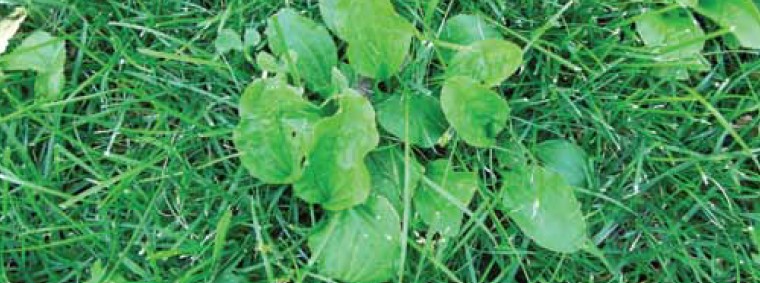
Broadleaf Plantain is common in lawns that are overwatered.
Herbicides also vary by the timing of application.
Preemergence herbicides are applied to the soil before weed seeds sprout. They are mostly used to control annual weeds. Read the label directions carefully, and water or rake in the product, or it won’t work. Most preemergence herbicides don’t kill existing plants, so emerged weeds will survive. Post-emergence herbicides are used to kill young, actively growing weeds. They are most often sprayed onto the leaves of weeds. Never spray a dead weed.
Use caution with weed-and-feed-type products
These products include both fertilizers and herbicides. When you apply them to entire lawns, you’re applying the herbicide everywhere, not just on the weeds, and using more than is needed. Instead, spot-treat weeds with a selective herbicide, and apply fertilizer separately when needed. When herbicides are used on entire lawns, your trees and other plants may be damaged or killed if the product gets into their roots underneath lawns or on suckers. Even trees and other plants some distance away from the lawn may be injured by the herbicide.
Tips for managing lawn weeds:
- Add organic matter to lawn soils for stronger turf and fewer weeds. Don’t add more than one-quarter inch of organic matter to an existing lawn at a time.
- Mow high (3 inches) for strong, deep grass roots.
- Accept a few weeds in your lawn.
- Pull or dig weeds when they first appear, before they make seed and become big problems.
- Avoid using weed killers or weed-and-feed-type products on entire lawns. They can damage adjacent trees and shrubs that have roots in the lawn area.
University of Nevada, Reno Extension
The above information is based on a printed factsheet (Fighting Weeds in Your Lawn) originally published in 2012.