One of your plants is suffering.
You know the problem is caused by an insect pest and you’ve identified the pest. Now what? How do you choose a method to control the pest? How do you protect the beneficial insects (good bugs) present in your landscape? Here are some lower-risk insect control options.
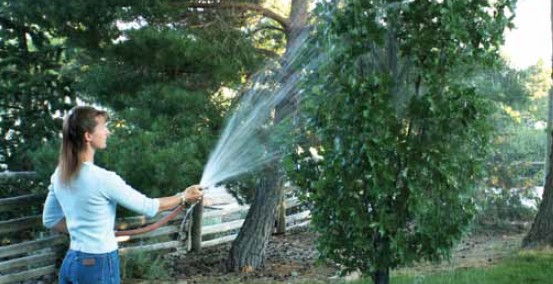
Wash off the pests.
A strong spray of water from your garden hose can help reduce pest numbers. The spray knocks the insect pests off your plants, interrupting their life cycle. Repeated spraying can make it difficult for pests to re-establish themselves on your plants. The increased humidity creates an atmosphere that some pests can’t tolerate.
Use diatomaceous earth on soft-bodied insects.
Some insect pests are soft-bodied, especially when they are young. Dusting susceptible plants with diatomaceous earth may help control these types of insect pests. Diatomaceous earth contains the powdered remains of silica-based diatoms. Soft-bodied insects avoid walking on the powder, as it is similar to humans walking on shards of glass. If eaten by insect pests, it can damage respiration, digestion and reproduction. Avoid breathing the dust during application.
Horticultural oils smother pests.
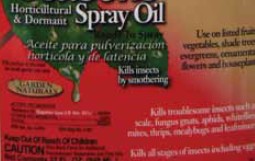
Horticultural oils (see example below) are another lower-risk method for controlling insect pests. Apply these oils to trees and other plants in your yard. With good coverage, they smother the insect pests and are especially useful in managing aphids, mites and scale. There are different types of horticultural oils, depending on the season of use and temperature. Some plants are sensitive to these oils, so check the label. Apply dormant oils before leaves emerge on trees and shrubs in late winter. Summer oils or foliar oils are lighter and can be applied later in the season when the leaves have emerged. Read the product label carefully to be sure you apply the product to the right plants at the right time of year or growth stage of the plants.
Completely coat pests with insecticidal soaps.
Insecticidal soaps are another low-toxicity method of insect control. These soaps must coat the insects, so spray plants thoroughly. Soaps must be applied within a certain temperature range. Read the label to find the temperature range for application. Make sure the product is safe to use on your specific plant and will control your specific pest.
Botanical insecticides are derived from plants.
The most common botanical insecticide is pyrethrum, which comes from chrysanthemums. Pyrethrum is not very toxic to birds or mammals, but may harm other non-target insects, such as bees. Apply pyrethrum early in the morning or in the evening when bees and other pollinators are not active to reduce harm to non-target beneficial (good) insects. Another common botanical pesticide is neem oil, from the neem tree. This botanical insecticide breaks down rapidly in the environment. It is not very toxic to mammals or birds. It is slightly to moderately toxic to fish and other aquatic animals. Insects must eat the oil for it to be effective, so bees and other pollinators are generally not harmed by neem oil. Bt does not stay active in the environment for long and will not harm most beneficial (good) insects.
Microbial insecticides target certain types of pests.
Microbial insecticides contain microbes that cause disease and death in certain insect pests. Microbial insecticides must be eaten by the insects in order to kill them. The most commonly used are products containing Bacillus thuringiensis, or Bt. The kurstaki variety of Bt controls many caterpillars. Bt variety israelensis controls black flies, fungus gnats and certain types of mosquitoes. Other varieties of Bt control beetles, grasshoppers and Mormon crickets.
If traditional products are needed, use a selective pesticide.
These products target specific types of pests and are less likely to harm the other good (beneficial) insects in your yard. Microbial insecticides are one type of selective pesticide.
Tips for selecting products:
- Start with the lowest-risk product that will do the job. This may be as simple as spraying plants with water.
- Consider trapping insects. Remember fly paper? Tried-and-true remedies, such as yellow sticky traps and tree trunk wraps, can help reduce the number of pests without using chemical pesticides.
- Select products that have the least harmful effects on people and pets. Look for the word “CAUTION” on the front label of the pesticide product.
- Use products that are selective for the pest, such as microbial insecticides.
- Consider the effects of the product on beneficial insects and pollinators. Natural enemies and pollinators are your friends. Protect them.
University of Nevada, Reno Extension
The above information is based on a printed factsheet (Lower Risk Insect Control Products) originally published in 2012.