Executive Summary
During the 2023-2024 program year, the urban Clark County Extension team reached 10,635 youth ages 5-18 and delivered 5,333 contact hours from which the 4-H team reached 4,805 youth and delivered 3,284 hours of programming and the remainder of the Extension departments reached 5,830 program participants with 2,049 contact hours. A total of 376 programs were delivered by the urban Clark County Extension team. 180 of those programs were led by 4-H across various delivery methods including special-interest programs, school-enrichment programs, after-school programs, chartered clubs, day camps, and overnight camps. The 4-H team reached 824 duplicated youth through single session workshops (244 youth, non-duplicate) and 5,475 duplicated youth duplicated youth (2,022 non-duplicate) through multi-session programs. 3,716 surveys were collected (4% were single session surveys and 96% were pre or post or both for multi session programs) (n=3,716).
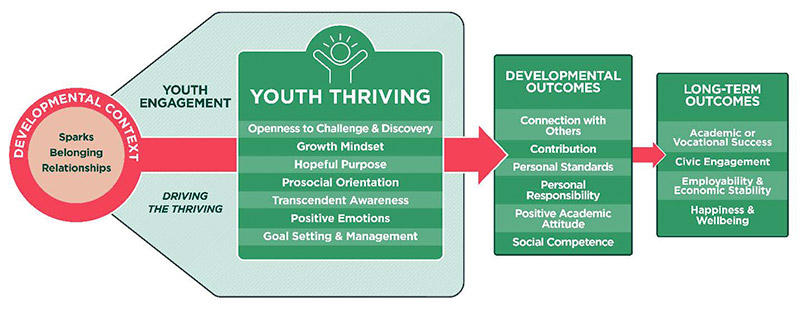
The 4-H Thriving Model is the theory of change for positive youth development (PYD) in 4-H. High-quality 4-H program settings provide youth a place to belong, matter and explore their personal spark. These components help ensure that 4-H programs provide a nourishing developmental context – a place where youth can grow. In the 4-H Thriving Model, the process of positive youth development is described by using seven indicators of thriving: a growth mindset, openness to challenge and discovery, hopeful purpose, prosocial orientation, transcendent awareness, positive emotions and, goal setting and management. The evaluation instruments were adapted from the Mediating Effects of Thriving on Youth Development studies (Arnold & Gagnon, 2019). See Figure 1: 4-H Thriving Model.
Of the participants who completed the survey for single-session workshops, most agreed that they liked the things they learned in the class. All of the survey respondents agreed that the adults in 4-H treated them fairly and most also had positive responses to the other items indicating strong positive outcomes for sparks, belonging and positive adult relationships – the basis of positive youth development. The majority of the single-session participants (70%) said they would come back for future 4-H classes.
Among participants in multi-session programs, a high satisfaction with 4-H was evident as most strongly agreed or agreed that they really liked the things they did in 4-H and the majority agreed with the positive statements related to belonging and positive relationships with adults. 56% said they would come back again and another 29% said they maybe would. Multi-session participants made positive changes related to a few of the items from the 4-H Youth Thriving Survey. Compared to the pre-survey, on the post-survey, a higher proportion of participants said, “Yes” (old version), or “Strongly Agree” (new version) that “I try new things even when they seem hard.” With respect to positive emotions, on the old survey version, compared to the pre-survey, a higher proportion of participants said that they talked about their feelings. Finally, compared to the pre-survey, in the post-survey, a higher proportion of participants who took the old survey version said that they asked for help when they could not solve a problem.
In summary, results of 4-H positive youth development programming show strong outcomes in the various areas of the 4-H Thriving Model. For youth who attended single-session 4-H workshops, the strongest results demonstrated an impact in youth sparks, positive adult relationships and belonging. For youth who attended multi-session 4-H programs, the strongest results demonstrated high levels of youth engagement with the program and that youth showed improvement in developing a growth mindset, strengthening positive emotions, and solving problems.
For the complete report, use the link below to download the PDF version.